Guides
Phoenix vs Seattle exterior repaint costs, how climate changes coating choices
Phoenix and Seattle exterior repaint costs diverge on sun, rain, prep and labor. Here are line-item ranges for both markets and how to quote each.
What to take away
- Phoenix exterior repaint pricing is product-heavy: elastomeric and reflective coatings cost more per gallon than standard acrylic.
- Seattle pricing is labor-heavy: mildew treatment, rot repair and rain delays add hours that Phoenix bids never carry.
- Elastomeric bridges the hairline stucco cracks that desert thermal cycling opens. Acrylic breathes, which keeps trapped moisture from pushing film off a damp Seattle wall.
- Prep is the swing line in both markets, and it is the line that grows after the wash reveals what the wall was hiding.
- Pull NOAA climate records for the metro before you set next season's production rate, not last year's job log alone.
Why the two markets price apart
Phoenix and Seattle attack a coating from opposite ends. Phoenix delivers ultraviolet radiation, heat and low humidity for most of the year. Seattle delivers rain, cloud cover and persistent damp.
Those forces break a film in different ways. Desert UV destroys binders and fades pigment. Pacific Northwest water softens the film, feeds mildew and rots the substrate behind it.
A system specified for one market fails early in the other. That matters to any contractor who bids remote work or runs crews in both states. Re-specify the system; do not reuse the specification.
Cost follows specification. Phoenix bids carry more product cost. Seattle bids carry more labor and prep. That split is the whole of exterior repaint pricing Phoenix Seattle coating costs.
Materials | NIST publishes weathering research that helps when a manufacturer's data sheet is thin on exposure claims. Contractors deciding which market to serve should read picking a market before building a second price book.
Elastomeric and acrylic, matched to each climate
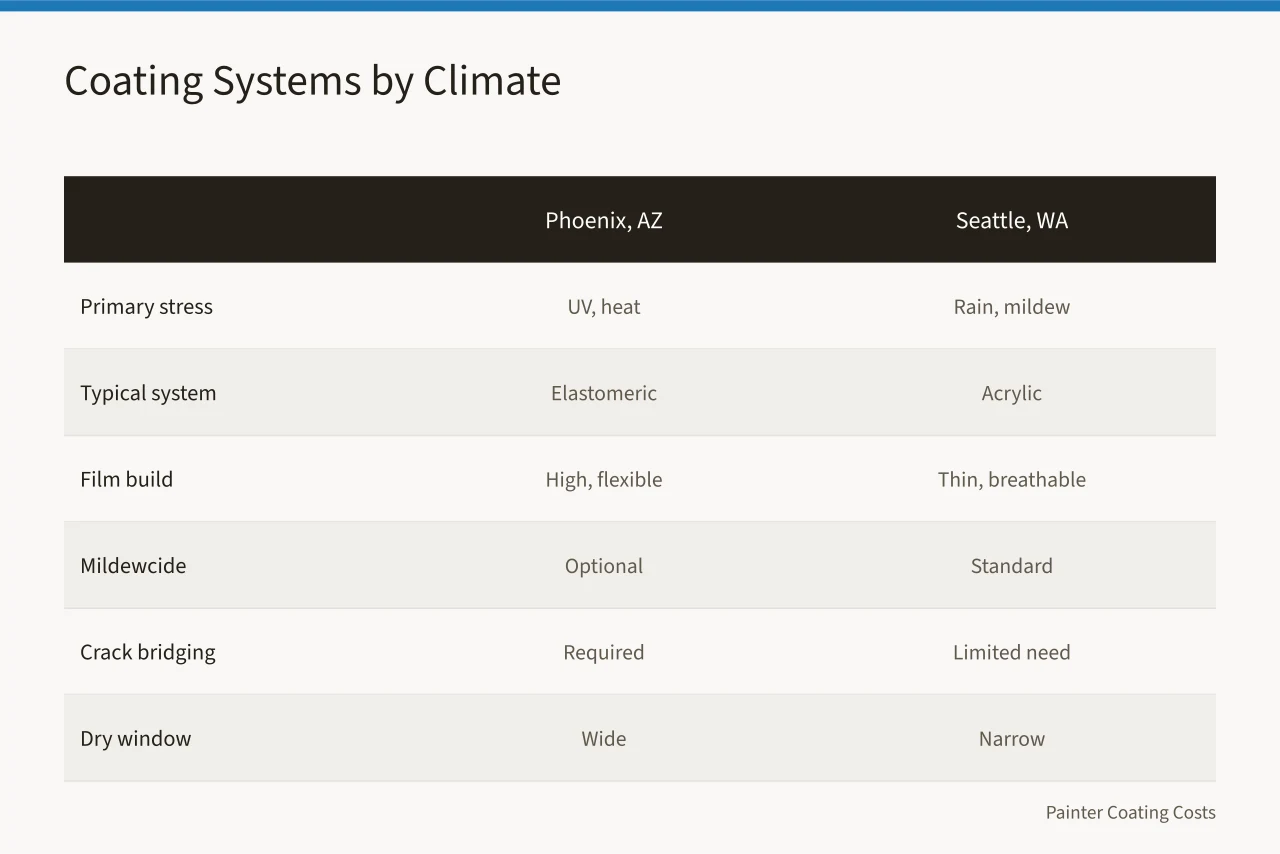
An elastomeric coating system is a high-build, flexible wall coating. It stretches with the substrate instead of cracking when the wall moves. Phoenix stucco and masonry expand and contract hard across a desert day, so that flexibility earns its cost.
Many elastomeric products carry reflective pigments or high total solar reflectance. A cooler surface means less thermal stress on the film.
An acrylic coating system is thinner and breathable. Water vapor passes through it, so trapped moisture cannot push the coating off the wall. In Seattle, breathability is the feature, not a compromise.
Seattle acrylic specs usually call for mildewcide in the film and a substrate treated for mildew before coating. North and west elevations stay damp long after a storm passes.
The two systems are not interchangeable. Elastomeric over a damp Seattle wall can trap moisture and blister. Thin acrylic over a Phoenix stucco crack simply cracks again.
| Factor | Phoenix, AZ | Seattle, WA |
|---|---|---|
| Primary stress | UV, heat, thermal cycling | Rain, damp, mildew |
| Typical system | Elastomeric coating system | Acrylic coating system |
| Film build | High build, flexible | Thin, breathable |
| Mildewcide | Optional | Standard |
| Crack bridging | Required on stucco | Limited need |
| Dry window | Wide, avoid peak heat | Narrow, watch rain |
Prep: dust and cracks in Phoenix, water and rot in Seattle
Phoenix prep is contamination and crack repair. Dust, pollen and desert grit block adhesion, so a pressure wash is standard and the wall usually dries fast.
Heat sets the schedule more than the prep list. Film can skin over before it bonds in peak afternoon heat, so early morning starts are normal on Phoenix exteriors.
Stucco cracks are the big Phoenix item. Hairline cracks get filled. On elastomeric jobs, the widest points may need fabric or mesh reinforcement.
Seattle prep is about water. Mildew, moss and algae grow on shaded elevations, and coating over anything still alive guarantees early failure. Washing removes growth but does not kill it, so treatment is a separate step.
The EPA's guidance on Mold | US EPA is what contractors cite when a homeowner asks why mildew treatment is not part of a standard wash.
Rot and soft trim are the second Seattle item. Sills, fascia and lower siding take the most water, and the damage usually surfaces after the wash, not before.
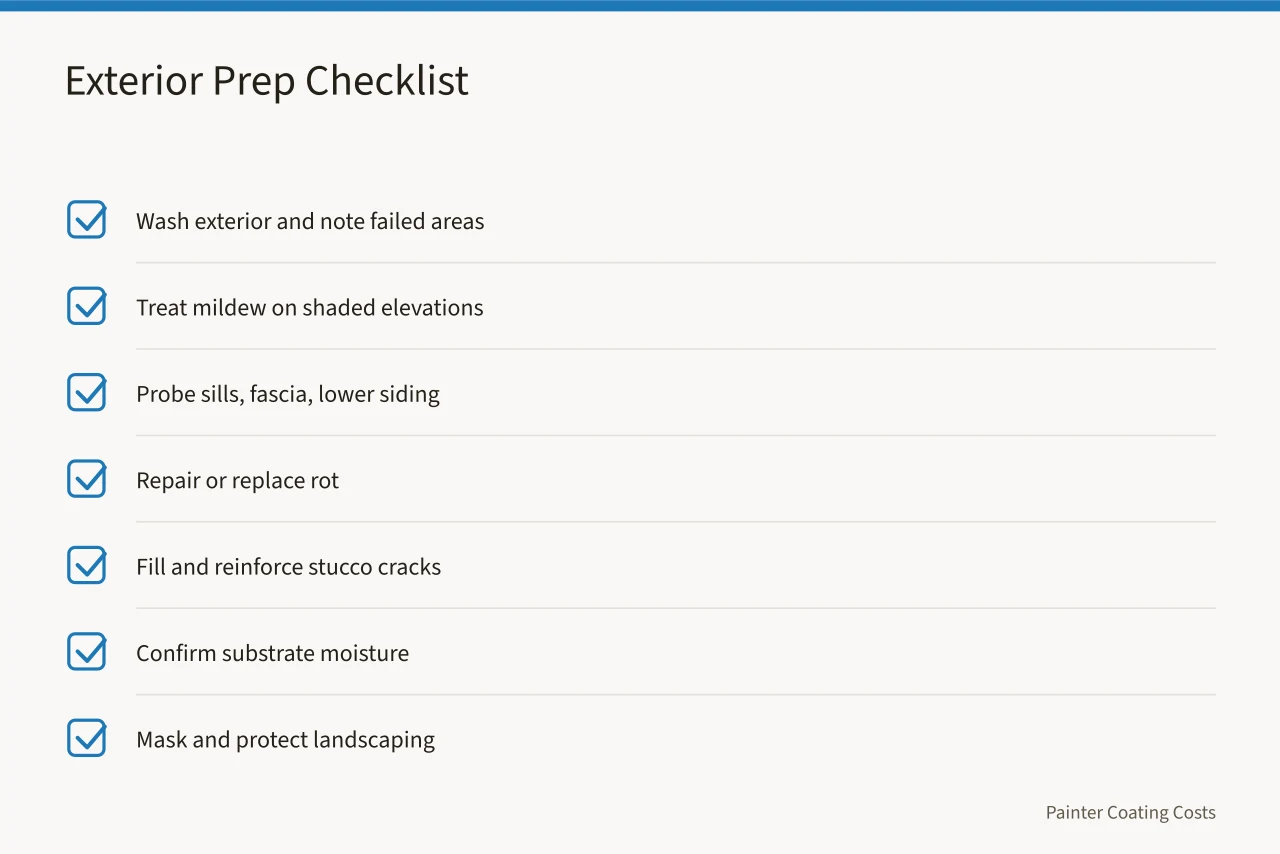
- Wash the full exterior and note failed areas
- Treat mildew on shaded elevations and let it dwell
- Probe sills, fascia and lower siding for soft wood
- Repair or replace rot before primer goes on
- Fill cracks and reinforce wide ones on stucco
- Confirm substrate moisture before the first coat
- Mask and protect landscaping and hardscape
Labor hours per square foot in Arizona and Washington
Labor is the largest line in most exterior bids, so hours per square foot drive the market gap. Phoenix crews move faster because weather rarely stops them.
Seattle crews lose hours to rain, dew and moisture checks. A wall that looks dry at 8 a.m. may still read too damp for coating, and the crew waits or moves to another elevation.
Production varies by substrate too. Smooth siding coats faster than rough stucco or brick. Two-story walls, steep rooflines and heavy landscaping add setup time in both markets.
Build your rate from your own crew data. The Bureau of Labor Statistics publishes painter and coating worker wages by metro, which is the cleanest starting point for a loaded rate in either state.
Grouping exterior work with higher-margin interior and specialty services smooths the seasonality that hits both markets. Profit by service covers how that mix works.
Line-item ranges for a Phoenix exterior repaint
Phoenix bids are product-heavy. Elastomeric costs more per gallon than standard acrylic, and reflective or high-build products sit at the top of that range.
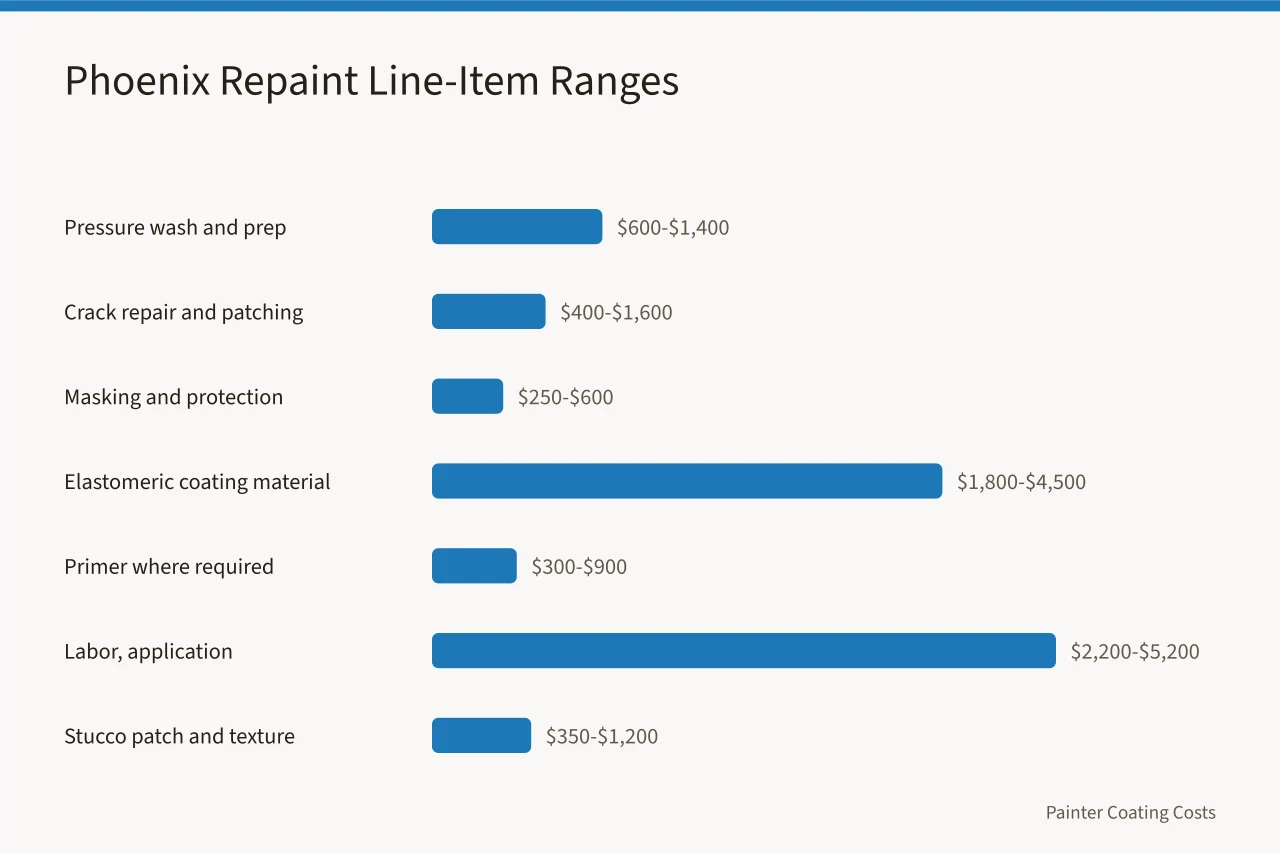
These are planning ranges for a single-family home in the Phoenix metro, not quotes. Substrate, access and condition move them.
| Line item | Low | High |
|---|---|---|
| Pressure wash and surface prep | $600 | $1,400 |
| Crack repair and patching | $400 | $1,600 |
| Masking and protection | $250 | $600 |
| Elastomeric coating, material | $1,800 | $4,500 |
| Primer where required | $300 | $900 |
| Labor, application | $2,200 | $5,200 |
| Stucco patch and texture match | $350 | $1,200 |
| Final walkthrough and touch-up | $150 | $400 |
Two-story homes, tile roofs needing protection and heavy desert landscaping push toward the high end. A single-story stucco home with good access lands near the low end.
Material choice is the biggest lever. Standard acrylic over sound stucco costs less than a full elastomeric system, but it will not bridge the cracks Phoenix heat opens.
Worked example: Phoenix stucco repaint
A 2,000 square foot single-story stucco home, sound substrate, moderate cracking, good access.
- Wash and prep: 16 labor hours at your loaded rate, plus wash equipment.
- Crack repair: 8 hours plus patch material and mesh at the widest cracks.
- Masking and protection: 4 hours across windows, doors and patio.
- Elastomeric application: two coats over roughly 2,000 square feet of wall area.
- Touch-up and walkthrough: 3 hours with the homeowner.
Total labor lands near 35 to 40 hours, and material is dominated by the elastomeric product. That structure is why Phoenix bids swing hard when a homeowner upgrades from acrylic to elastomeric.
Line-item ranges for a Seattle exterior repaint
Seattle bids are labor-heavy. Material is often a mid-grade acrylic, but prep, moisture control and weather delays add hours Phoenix bids do not carry.
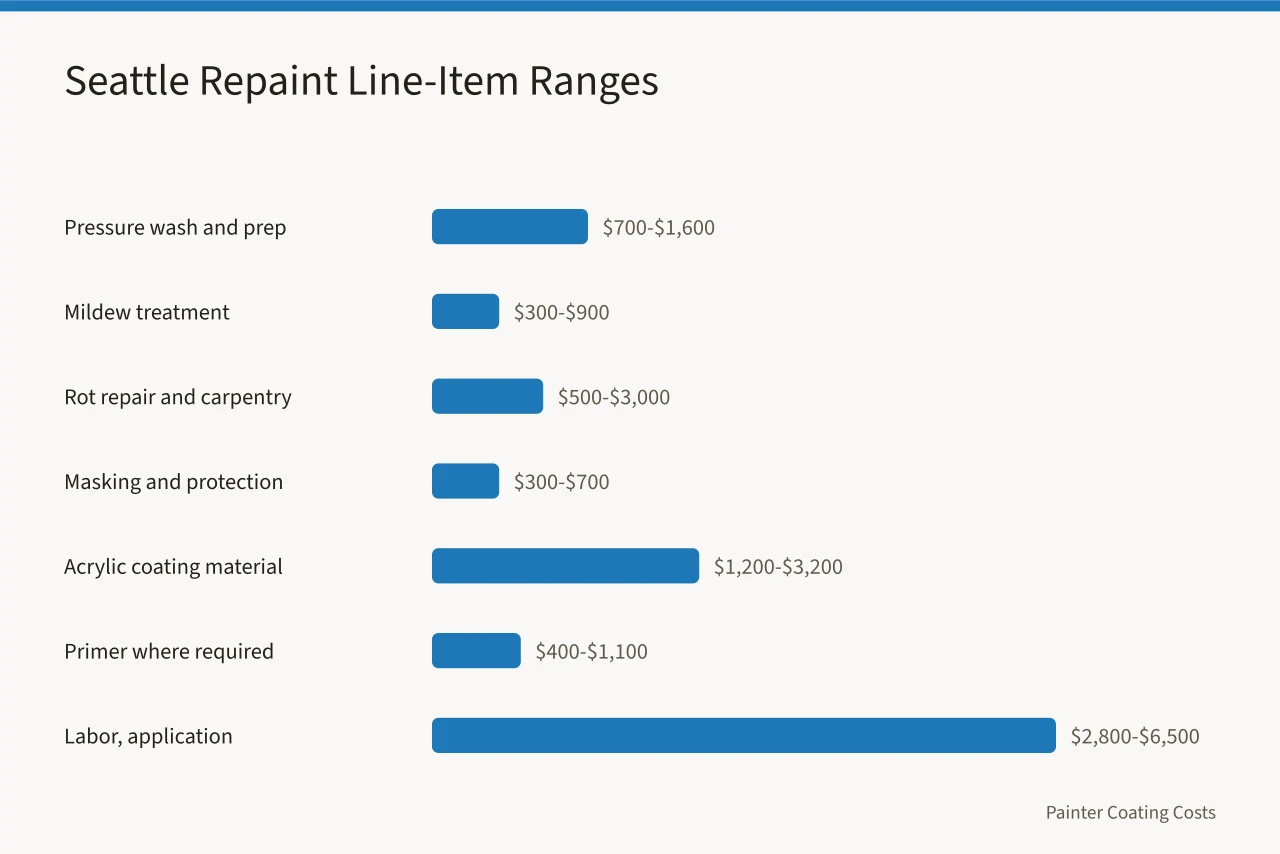
These are planning ranges for a single-family home in the Seattle metro, and they move with substrate, access and condition.
| Line item | Low | High |
|---|---|---|
| Pressure wash and surface prep | $700 | $1,600 |
| Mildew treatment | $300 | $900 |
| Rot repair and carpentry | $500 | $3,000 |
| Masking and protection | $300 | $700 |
| Acrylic coating, material | $1,200 | $3,200 |
| Primer where required | $400 | $1,100 |
| Labor, application | $2,800 | $6,500 |
| Final walkthrough and touch-up | $200 | $500 |
Rot repair surprises homeowners most, and it grows most often after the wash reveals soft trim and siding edges.
Weather delay is real cost. A crew that loses two days to rain still has to be paid, scheduled and moved, and those hours land somewhere in the bid.
Worked example: Seattle siding repaint
A 2,000 square foot single-story home with lap siding, moderate mildew on shaded elevations, some soft trim.
- Wash and prep: 18 labor hours, plus wash equipment.
- Mildew treatment: 5 hours including dwell time and rinse.
- Rot repair: 10 hours plus lumber and primer for bare wood.
- Masking and protection: 5 hours across windows, doors and deck rails.
- Acrylic application: two coats over roughly 2,000 square feet of wall area.
- Touch-up and walkthrough: 3 hours with the homeowner.
Total labor lands near 45 to 55 hours before any weather delay. That gap against the Phoenix example is the labor story of these two markets.
Build either price book from prices for profit, not from a competitor's phone quote.
Reading NOAA climate data before you quote
The National Oceanic and Atmospheric Administration publishes the regional records that explain this price split. Climate | National Oceanic and Atmospheric Administration is the entry point for temperature, precipitation and drought context by region.
For Phoenix, track days above 100 degrees, ultraviolet intensity and annual precipitation. Those set dry time, application windows and how fast a coating chalks or fades.
For Seattle, track rain days, humidity and the length of the dry season. Those set how many working days a crew can realistically book.
Storm records matter in both markets. Weather | National Oceanic and Atmospheric Administration carries the data contractors cite when they price hail, wind or freeze damage as a separate repair scope.
The routine: pull several years of local climate data, compare it against your own job logs, then adjust production rate and season length before setting next year's prices.
Climate shapes demand timing as much as cost. Work through painting contractor startup costs so weather assumptions sit on top of a funded budget. Running hot-dry and wet-cool markets from one operation takes two price books and two crew schedules; Expansion and market covers what that requires.
Common questions
Why is an elastomeric coating system standard in Phoenix but not in Seattle?
Elastomeric films are high build and flexible, which suits stucco that moves with desert heat and cracks over time. In Seattle that same film can trap moisture against a damp wall. Specify acrylic there instead.
Does Seattle really need a separate mildew treatment line item?
Yes. Washing removes surface growth but does not kill mildew rooted into the substrate, and coating over live mildew leads to early failure. Treatment is a separate step with its own dwell time.
How much do weather delays add to a Seattle exterior repaint?
It varies by season and elevation. A crew that loses two working days still carries those hours, so most contractors build a weather allowance into the bid rather than absorb it later.
Can I use the same labor rate in both markets?
No. Loaded rates, crew productivity and available working days differ enough that each market needs its own rate. Build both from your own job cost data, starting with BLS wage figures for the metro.