Guides
Does a Canadian Painting Contractor Add GST or HST to Quotes?
GST HST painting contractor Canada rules decide whether a quote includes tax. Small supplier thresholds, provincial PST and CRA registration are covered here.
What to take away
- A painter registered for GST/HST must charge it on the invoice, and the rate depends on the province where the customer and the property sit.
- Below the small supplier threshold, registration is optional, so many quotes show no tax at all until the painter crosses it.
- Quebec, British Columbia, Saskatchewan and Manitoba run their own sales taxes, so a GST number alone does not cover every job.
- Charging tax without remitting it is the fastest route to a reassessment, penalties and interest from the Canada Revenue Agency.
- A quote should state plainly whether tax is included or added, because the customer pays the difference either way.
Who has jurisdiction over sales tax
The Canada Revenue Agency administers the goods and services tax and the harmonized sales tax under the Excise Tax Act. That is a federal statute, and it applies in every province and territory.
Three provinces run their own retail sales tax instead of the harmonized version. British Columbia charges provincial sales tax, and the provincial guidance on PST registration and rates sets out what applies to goods and services there. Saskatchewan and Manitoba operate similar systems. Quebec collects its own tax through Revenu Quebec.
Ontario, the Atlantic provinces and the territories use the harmonized tax, so one rate covers both levels. The structure of the harmonized tax explains which provinces participate and which do not.
Two layers of rule sit on top of the tax question. Municipal business licensing decides whether a painter may operate in a city at all. Private rules, such as a condominium corporation's bylaws, decide who may work inside a building. None of those replace the tax registration requirement.
What triggers registration
Registration turns on revenue, not on the size of any single job. A painter whose taxable supplies stay under the small supplier threshold in four consecutive calendar quarters is not required to register.
- Track taxable revenue by calendar quarter, not by fiscal year.
- Include labour, materials and any markup in the total.
- Exclude exempt supplies and zero-rated supplies from the count.
- Register within the deadline once revenue crosses the threshold.
- Keep the registration number on every invoice after that date.
The threshold applies to the business as a whole. A painter who runs two crews under one business number does not get two thresholds.
The threshold is a rolling figure. A strong spring can push a painter over it in a single quarter, and the obligation starts from the sale that crossed the line, not from the following year.
What a compliant quote shows
A quote is not a tax document, but the wording on it decides what the customer expects to pay. The Canada Revenue Agency's guidance for GST/HST registrants covers registration, charging and remitting in one place.
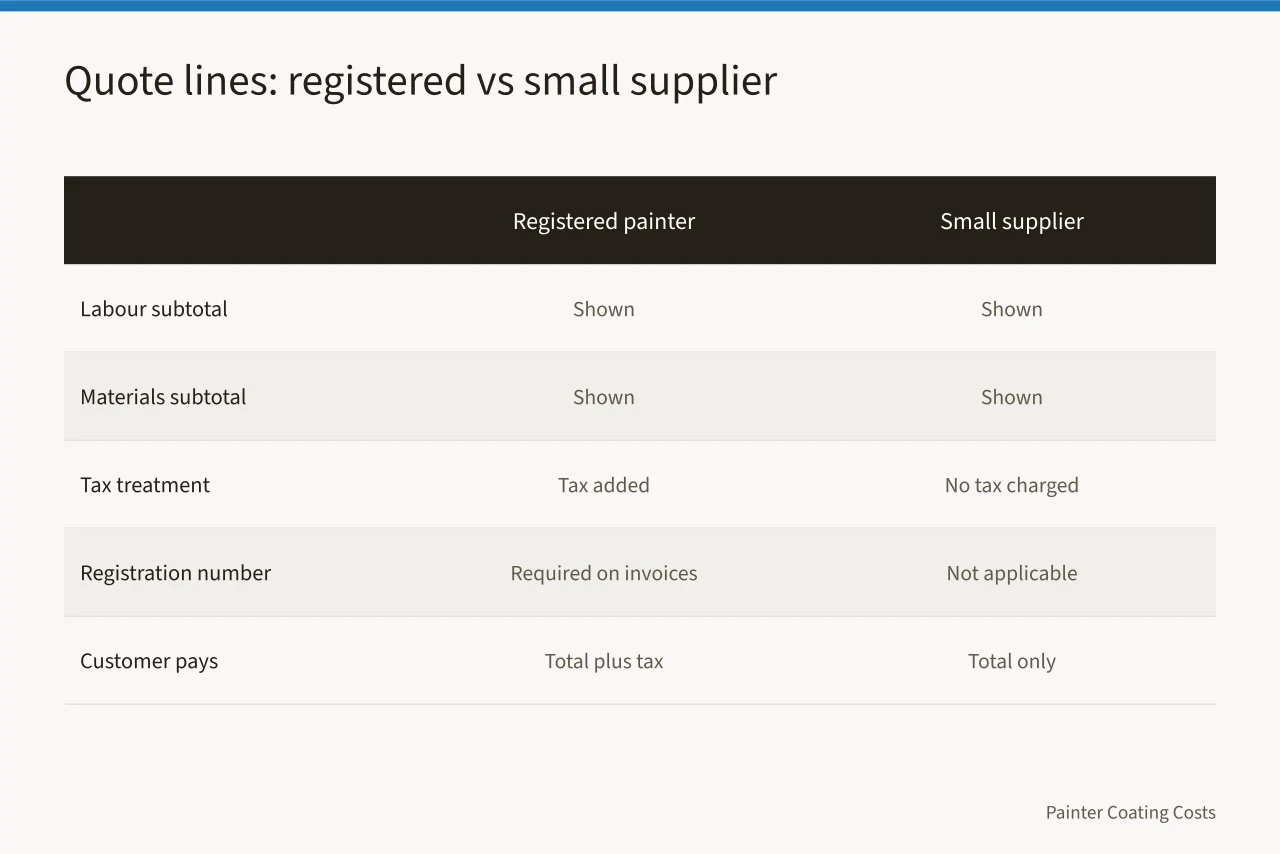
| Line on the quote | Registered painter | Small supplier |
|---|---|---|
| Labour subtotal | Shown | Shown |
| Materials subtotal | Shown | Shown |
| Tax treatment | Tax added at the local rate | No tax charged |
| Registration number | Required on invoices | Not applicable |
| Customer's expectation | Pays the total plus tax | Pays the total only |
The rate depends on where the property is, not where the painter lives. A contractor based in one province who paints a building in another charges the rate that applies at the job site.
How the provinces differ
A painter who works across a provincial boundary needs more than one registration. The harmonized provinces take a single combined rate. The separate provinces take the federal tax plus their own.
Quebec is the clearest example. A painter registered there deals with Revenu Quebec for the provincial portion and with the federal agency for the rest. British Columbia works the same way in principle, with the provincial tax collected separately.
Residential repainting is generally taxable in every province. New housing construction and some substantial renovation work can be treated differently, and that distinction is worth confirming before a large contract is signed. A painter who mostly repaints occupied homes rarely meets that exception.
The consequence of getting it wrong
A painter who charges tax and keeps it faces a reassessment for the full amount plus interest and a penalty. A painter who should have registered and did not faces the same bill, calculated as though the tax had been charged, and cannot go back to the customer to collect it.
That is the part nobody mentions until afterwards. The contractor absorbs the tax out of the job margin, and on a large repaint that can exceed the profit on the work. The customer has already paid the quoted price and owes nothing more.
Failing to charge tax also leaves the painter unable to claim input tax credits on materials. Paint, primer and sundries carry tax at purchase, and a registered business recovers it. An unregistered one does not.
Common questions
Does a painter have to charge tax on labour?
Yes, once registered. Painting labour is a taxable supply, and there is no separate treatment for labour versus materials in the harmonized provinces.
Can a small supplier charge tax voluntarily?
A business below the threshold may register voluntarily, which allows input tax credits on materials. It then must charge tax on every taxable sale.
What if the customer is a business?
A registered business customer will want the tax shown separately so it can claim its own credit. A quote that buries tax in a lump sum creates a problem at their end.
Does a condominium change the tax answer?
The tax treatment follows the contract, and the corporation is the customer in a common-area repaint. The corporation's own registration status decides how it handles the invoice.