Guides
Which IRS rules decide employee status for US painting crews?
The common-law test, not the contract label, decides whether a painting crew member is an employee or a contractor for federal tax purposes.
What to take away
- The IRS decides employee status from the facts of the working relationship, not from a contract clause that says "subcontractor."
- Behavioral control, financial control, and the type of relationship are the three buckets; a painter who fails all three is an employee.
- Form 1099-NEC is due to the IRS and to the painter by January 31 once payments reach $600 for the year.
- A genuinely self-employed painter files Schedule C and Schedule SE and pays self-employment tax on net profit.
- Misclassification exposure is the employer's share of employment tax plus interest and penalties, and it grows with payroll size.
The common-law test, applied to a real painting crew
Handing a brush to a helper and calling that helper a subcontractor settles nothing. The Internal Revenue Service decides employee status from the facts of the arrangement, and the starting point is the common-law test: does the business have the right to control what the worker does and how the worker does it?
The right to control matters more than whether the owner actually exercises it. A crew leader who can say which wall to cut in, when to break, and which product to roll is exercising control whether or not he raises his voice.
In a painting business the test shows up in small decisions. Who buys the paint? Who supplies the ladders, sprayers, and masking paper? Who sets the start time? Who decides whether a homeowner complaint goes back to the same painter? Every answer that points at the owner points toward employee status.
The IRS treats the common-law test as a framework, not a checklist of job titles. It looks at the whole relationship. A signed agreement that says "independent contractor" does not override what happens on the job.
The test runs the other way too. A subcontractor who bids a fixed price for a defined scope, brings a crew, carries insurance, and can work for other builders has real independence, and that arrangement can survive review when the paperwork and the practice match.
Federal tax law sets a floor, not a ceiling. States run their own wage, unemployment insurance, and workers' compensation programs, and some license painting contractors directly through boards such as the Texas Department of Licensing and Regulation and the California Contractors State License Board. A business that passes the IRS test can still fail a state audit.
Classification is decided before the first painter shows up. Documenting scope, pay basis, and tools at hiring builds the file an examiner will ask for, and the steps in this guide to painting contractor workers translate directly into that audit file.
The agency's own plain-language guidance on independent contractor or employee questions is the place to start.
Behavioral, financial, and relationship factors on the job
The IRS sorts the common-law factors into three buckets: behavioral control, financial control, and the type of relationship. Painting crews give clean examples of each.
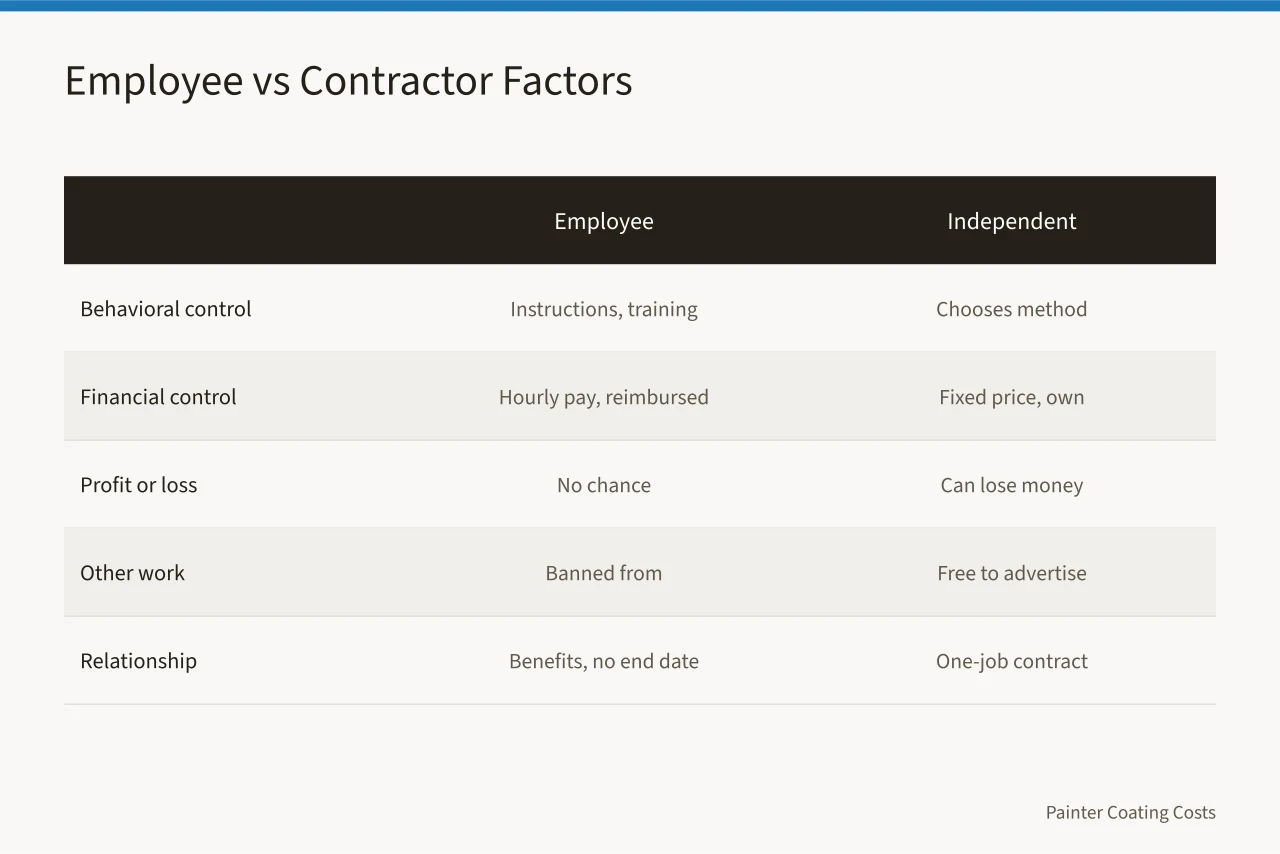
Behavioral control covers instructions and training. Tell a painter which primer to use on a stained ceiling, how many coats to apply, and in what order to work the rooms, and you have behavioral control. Let the painter choose the method and the sequence, and control leans the other way.
Training is the strongest single signal. A company that runs its own onboarding, teaches spray technique, and corrects work in progress is training employees. A company that hires a finisher who already knows the trade and needs no instruction is closer to buying a service.
Financial control covers the money. An employee is paid by the hour or week, gets materials reimbursed, and has no real chance of profit or loss on the job. An independent painter quotes a price, buys materials, and can lose money when a job runs long.
A painter free to advertise and take other builders' work has financial independence. A painter told not to work for competitors, and who depends on one company for every hour, does not.
Relationship factors cover benefits, duration, and intent. Paid vacation, health coverage, and a relationship with no end date point to employment. A one-job contract with a clear completion date points to contracting.
Real jobs rarely fit one bucket. A crew that has worked for the same builder for three years, uses the builder's equipment, and gets paid weekly looks like employees on every factor. A two-week punch-out crew that brings its own gear and bills by the room looks independent.
The honest test: could the painter take the same work from another builder tomorrow without asking permission? If not, the relationship is employment in substance, whatever the invoice says.
Owners who want the independent path to hold should build the business around it. A company that hires and trains its own core crew and uses true subcontractors only for defined scopes has a defensible structure.
Form 1099-NEC: the $600 threshold and the January 31 deadline
Form 1099-NEC reports nonemployee compensation. A painting business files it for each non-employee paid at least $600 during the year for services.
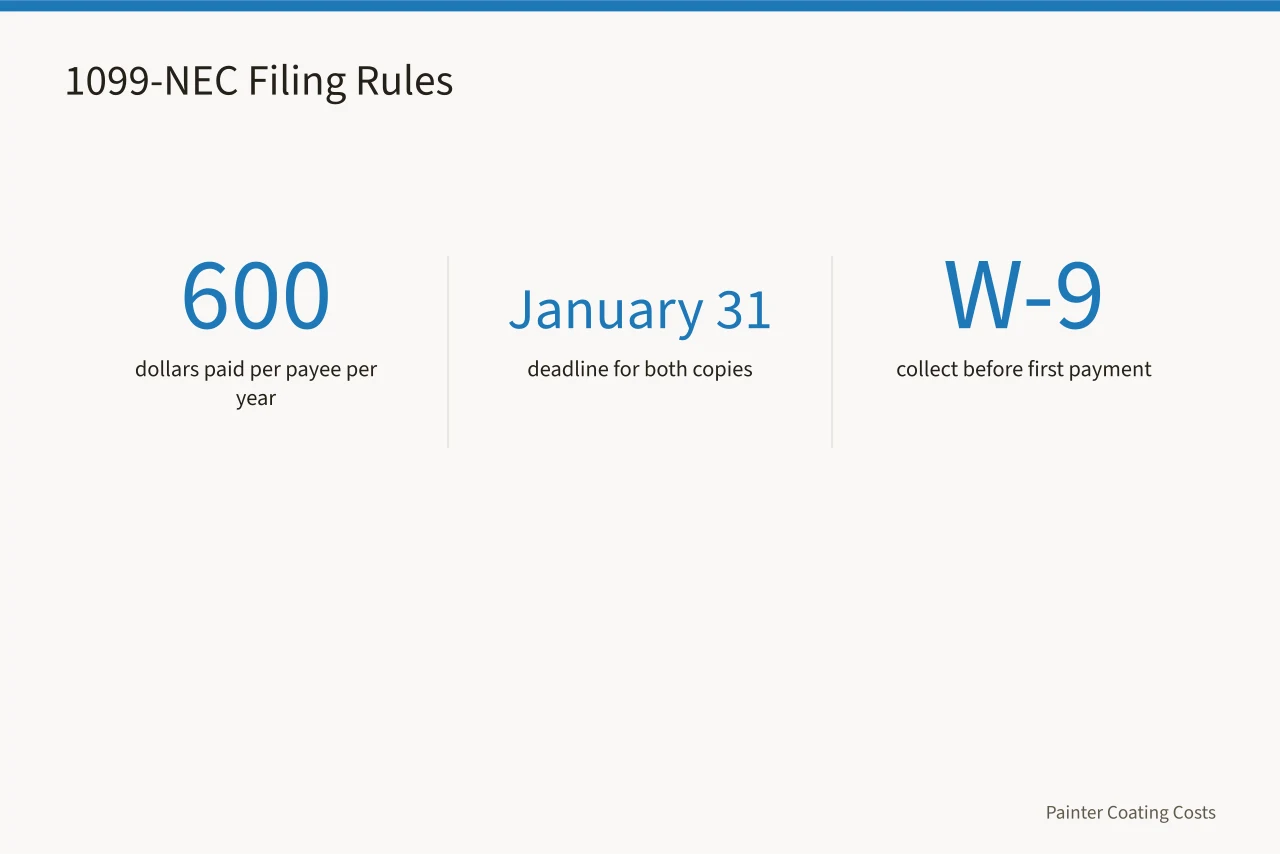
The threshold is per payee, per year, not per job. Four payments of $200 to the same painter cross the line. Payments routed through a third-party network may be reported on a different form, so check how the money moved before deciding.
Both copies, to the IRS and to the recipient, are due by January 31 of the following year. The recipient copy has no automatic extension. A late or missing form draws a penalty per form, and the penalty rises with how long the form is late.
The IRS states the purpose and the threshold in its own guidance on Form 1099-NEC, and expects the payer to keep the payee's name, address, and taxpayer identification number on file.
Collect a Form W-9 before the first payment and the paperwork problem mostly disappears. A painter who refuses a taxpayer identification number, or gives one that does not match IRS records, can trigger backup withholding.
Corporations are generally exempt from 1099-NEC reporting for services. An LLC that files as a sole proprietor or partnership is not. Sort the entities before January if you pay a mix of crews.
Two errors recur. The first is reporting gross job payments that include materials; the form covers services, and reimbursed supplies belong in separate records for painting contractor services. The second is filing the form and never sending the painter a copy. The recipient copy is what the painter needs to report the income.
Timing is a federal rule, not a state one. Pay a punch-out contractor $250 in March, $250 in June, and $250 in September and you have paid $750 for the year. Both copies are then due by January 31.
Schedule C and Schedule SE when the painter is truly self-employed
A genuinely self-employed painter reports business income and expenses on Schedule C, filed with Form 1040, covering a sole proprietorship.
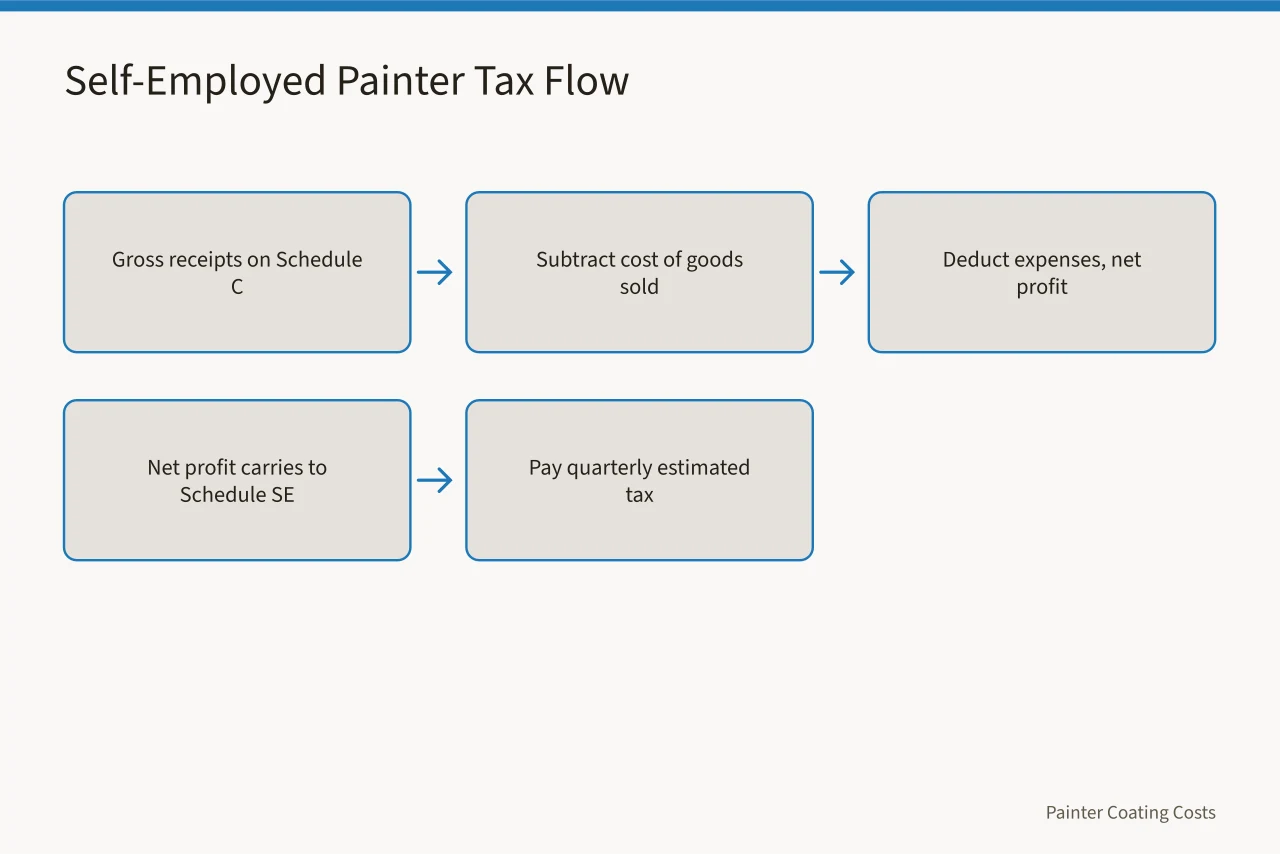
Gross receipts go at the top, and cost of goods sold comes off first. Paint, tape, and plastic belong in that block. Ladder replacement, vehicle expense, insurance, and the fee paid to a helper go in a later section and reduce net profit.
The IRS describes Schedule C as the profit or loss form for a sole proprietorship. A painter who files it can also deduct the business portion of a home office, a phone, and tools, if the records support the claim.
Net profit carries to Schedule SE, which computes self-employment tax covering Social Security and Medicare. That tax sits on top of income tax and is based on net earnings. A painter with $60,000 of net profit pays it on most of that amount, and half of the tax is deductible for income tax purposes.
Quarterly estimated payments matter. A painter with no paycheck withholding must send estimated tax during the year or face an underpayment penalty in April.
A painting business that pays its own crew as employees does not file Schedule C for those workers. It runs payroll and issues Form W-2. Employee payroll and sole proprietor Schedule C are mutually exclusive for the same worker in the same year.
A single-member LLC changes nothing here. It is a disregarded entity for federal tax, so the owner still reports on Schedule C by default. An EIN, a business bank account, and a clean expense record make that return defensible and make an audit shorter.
Penalty exposure when painters are misclassified
Reclassify painters as employees and the business owes the employer's share of Social Security and Medicare tax, plus the federal income tax that should have been withheld. Interest accrues from the date the tax was originally due.
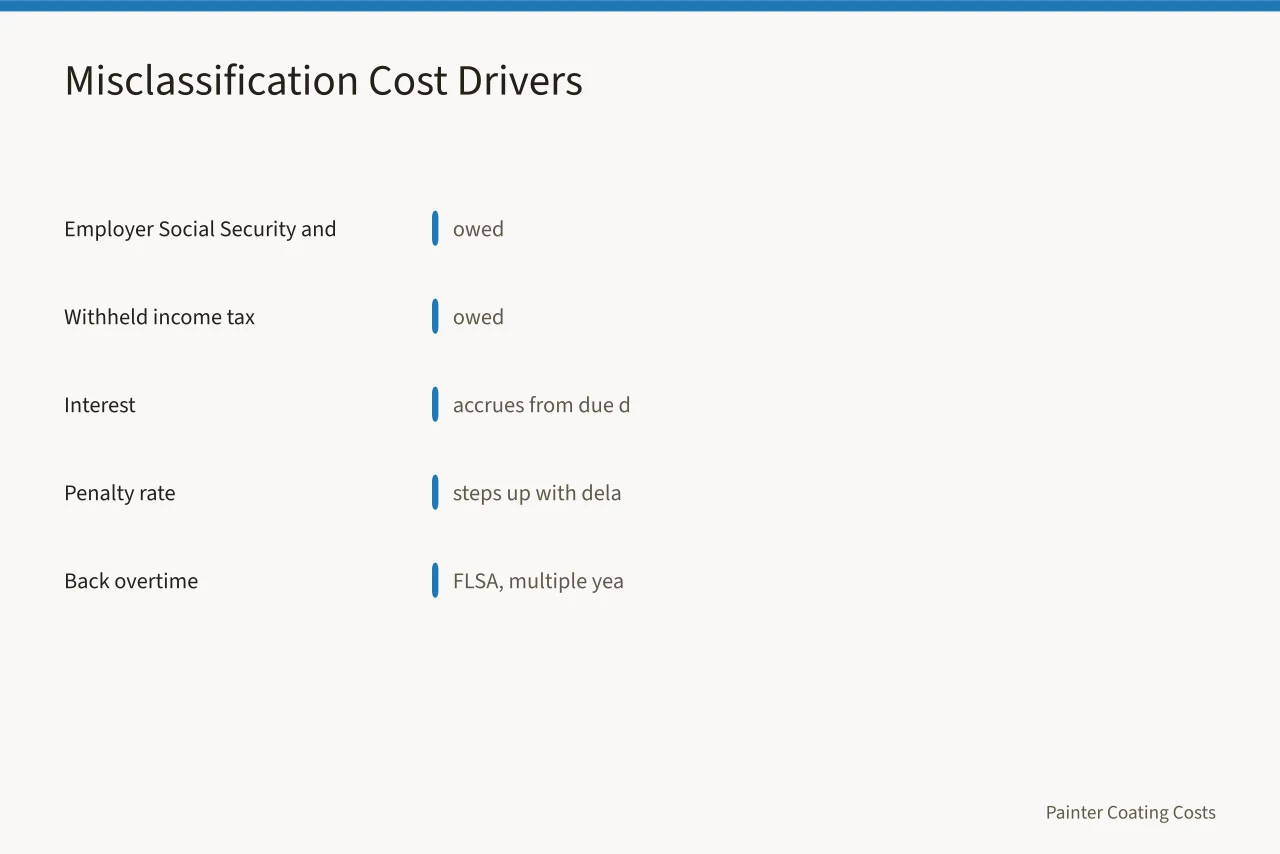
Failing to deposit or pay employment tax carries a penalty set as a percentage of the unpaid amount, and the rate steps up with the length of the delay. Failure to file and failure to pay each add their own penalty.
Intent matters. A business that knew the rules and ignored them faces a higher penalty than one that made a good-faith mistake. Records showing how the classification was decided help in the second case and do nothing in the first.
Exposure grows with payroll size. Ten painters paid for three years produces a far larger bill than one painter paid for one season. State agencies can stack unpaid unemployment insurance, workers' compensation premiums, and their own penalties on top of the federal amount.
Back pay can follow. A reclassified painter may be owed overtime under the Fair Labor Standards Act if hours topped forty in a week and no overtime was paid, and that claim can cover multiple years.
Filing a 1099 is a reporting duty, not a legal shield. The IRS can still examine the relationship and reclassify the worker.
Section 530 of the Revenue Act of 1978 gave limited safe harbor to businesses meeting certain consistency and reporting tests, but its application is technical and has narrowed over time.
An owner facing an audit should get tax counsel rather than rely on a summary.
The practical defense is consistency. A painting business that treats a worker as an employee for payroll, workers' compensation, and unemployment, and as a contractor for nothing, has no mixed signals to explain.
The opening rules for a painting contractor business cover the filings that keep those signals aligned, and the agency's main business tax portal gathers the employee status and payroll rules in one place.
DOL and FLSA overlap with the IRS test
The IRS test is not the only test. The Department of Labor enforces the Fair Labor Standards Act, which covers minimum wage and overtime, and it runs its own analysis of who is an employee.
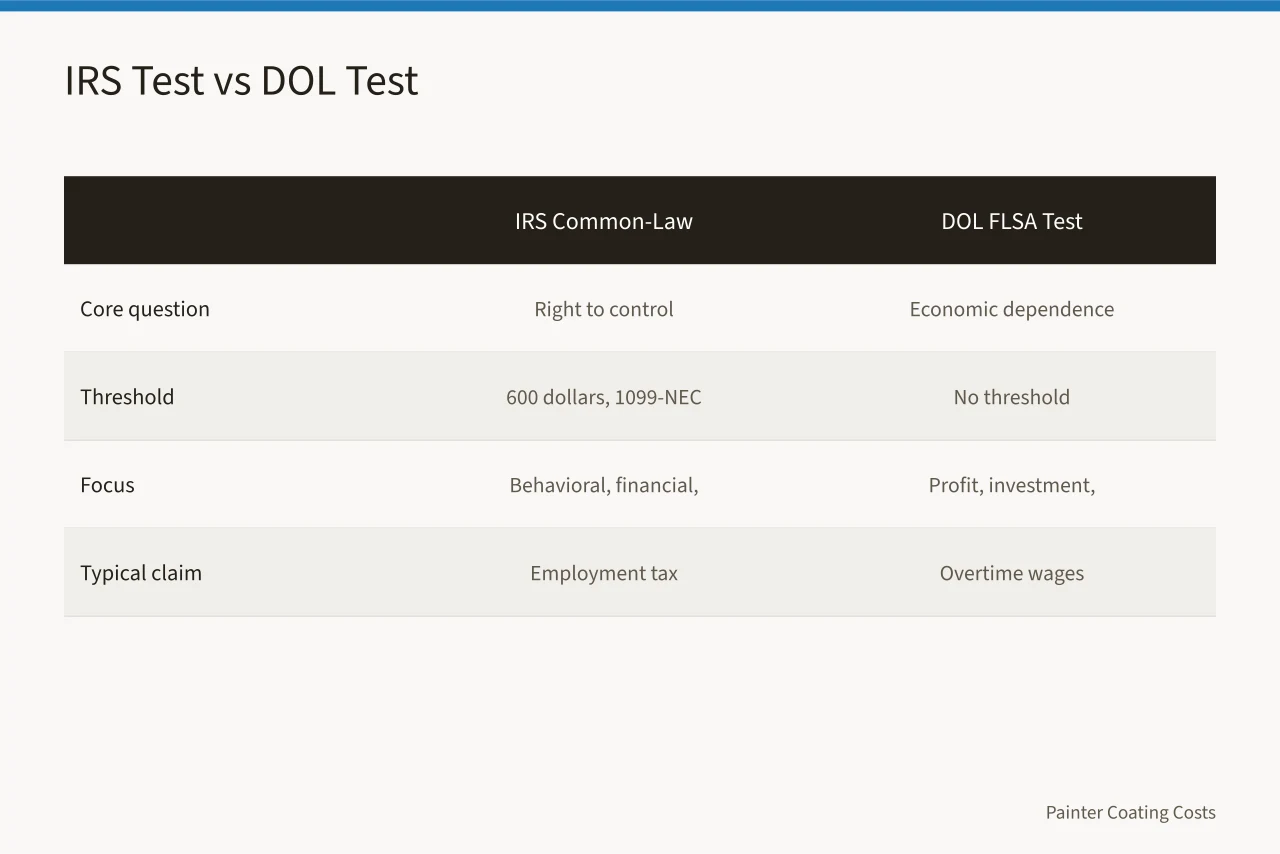
The Wage and Hour Division has published guidance on misclassification under the FLSA, focused on whether the worker is economically dependent on the employer for work.
The DOL weighs the worker's opportunity for profit or loss, the worker's investment, the skill required, the permanence of the relationship, and how much control the employer has. Those factors overlap with the IRS factors without being identical.
A painting business can pass one test and fail the other. The FLSA has no $600 threshold and no annual form. It applies to covered employees from the first hour worked.
Overtime is the usual FLSA claim in painting. A painter on a day rate who works fifty hours in a week may be owed overtime for the hours over forty unless a specific exemption applies, and painting work rarely meets the white-collar exemptions.
The DOL can recover back wages plus an equal amount in liquidated damages, and can seek an injunction against the practice.
State labor agencies in California, New York, Illinois, and Washington run parallel enforcement under their own tests.
OSHA and EPA rules add a layer. A painting business sending workers into a lead-painted home must follow the EPA Lead Renovation, Repair and Painting Rule, and the duty to train and certify applies to employees. Calling those workers contractors does not remove the training duty.
Workers' compensation is a separate state matter. A company that classifies a regular crew as contractors may still owe premiums when a painter is injured, and the state fund can audit the payroll records.
One rule covers most of it: if a painter works like an employee under the IRS factors, assume the FLSA and the state rules will treat that painter as an employee too. Planning for the stricter test costs less than losing two audits.
Paperwork that keeps the classification defensible
A classification is only as strong as the file behind it. Keep these documents for every worker you call a contractor.
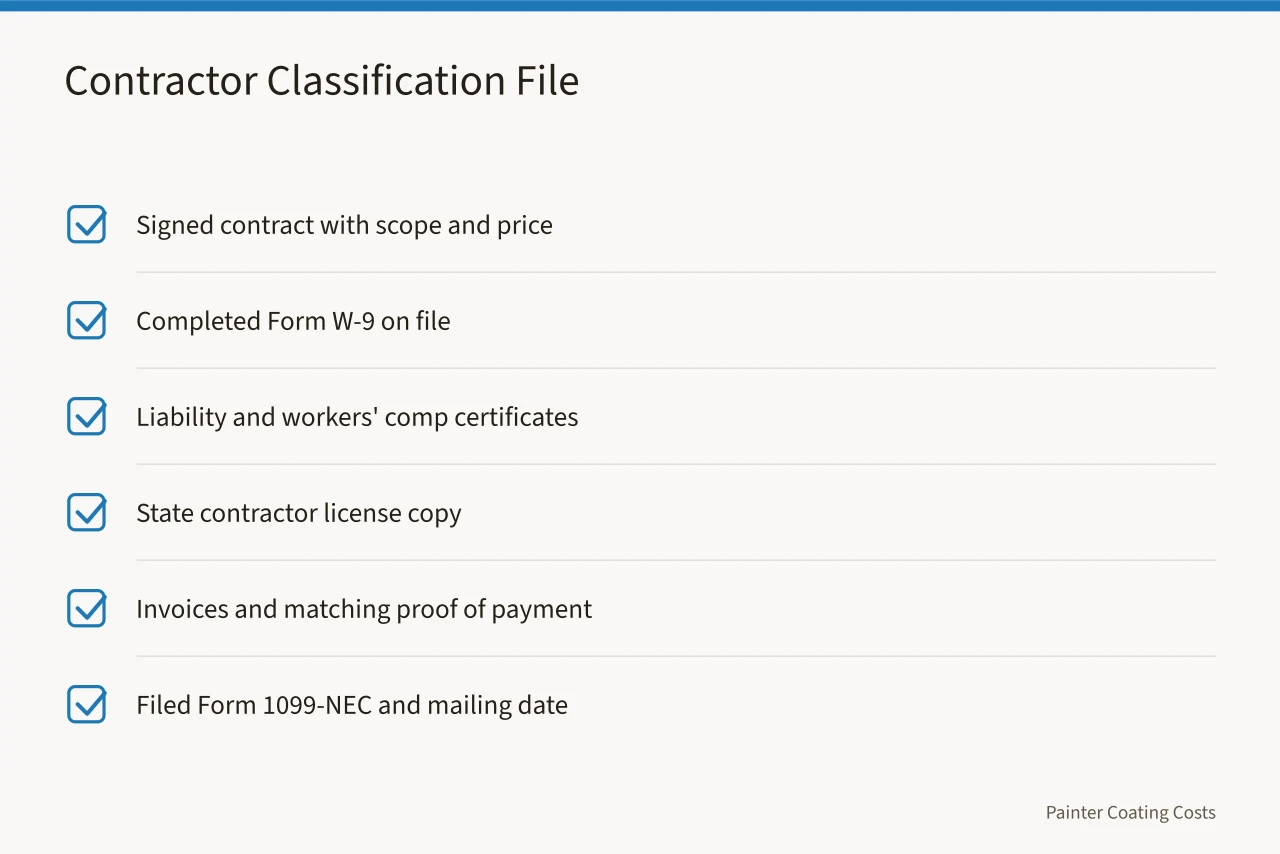
- A signed contract naming the scope of work, the fixed or unit price, and the completion date.
- A completed Form W-9 with the painter's legal name, business name, address, and taxpayer identification number.
- A certificate of general liability insurance and, where required, workers' compensation coverage.
- A copy of the painter's state contractor license or registration, if the state requires one for the trade.
- Invoices showing the job address, the scope, and the amount billed.
- Proof of payment matching the invoices, kept apart from payroll records.
- A copy of the filed Form 1099-NEC and the date the recipient copy went out.
The contract should not read like an employee handbook. Daily hours, mandatory company meetings, and a ban on working for other builders all undercut the independent claim.
Write the reasoning down when the relationship starts, not after an audit notice arrives. A short memo naming the factors and the evidence behind them is enough.
Keep the company's own records clean. A separate EIN, a business bank account, and a payroll system for employees make it obvious which workers sit on which track.
Insurance and licensing paperwork is not only for the audit file. General contractors and homeowners ask for certificates, and an uninsured painter can create a liability that lands on the painting company.
A short annual review catches drift. Compare the contractor list against the actual working pattern once a year and move any de facto employee onto payroll. Converting a long-term painter is cheaper than defending three years of back tax.
When status is genuinely unclear, the business can file Form SS-8 and ask the IRS for a determination. It takes time, and the answer applies to the facts presented, but it creates a record of good-faith effort.
Pay levels and classification interact. A crew paid at the bottom of the market is more likely to be treated as employees, because the company controls the schedule to hold costs down. Rates that reflect a real subcontractor margin support the independent story, and the market data on what to pay painting contractor staff helps an owner set them.
Common questions
Does a signed independent contractor agreement decide the worker's status?
No. The IRS and the DOL look at the actual working relationship, and a contract label does not override the facts. The agreement helps show intent, but control, pay, and duration carry more weight.
When is Form 1099-NEC required for a painter?
The form is required when a non-employee is paid at least $600 for services during the year. It is due to the IRS and to the recipient by January 31 of the following year.
Can a painting company pay a crew by the day and still call them contractors?
Day-rate pay is a financial control factor pointing toward employment, especially when the company sets hours and supplies the tools. A fixed price for a defined scope is a stronger contractor arrangement.
What happens if the IRS reclassifies painters as employees?
The business owes the employer's share of employment tax, withheld income tax, interest, and penalties. State unemployment and workers' compensation liabilities can follow.
Does the FLSA use the same test as the IRS?
No. The DOL applies an economic dependence analysis under the FLSA, and a business can fail that test even when it passes the IRS common-law test. Overtime claims are the usual result.