Guides
What It Costs to Paint Kitchen Cabinets per Linear Foot
Cabinet painting cost per linear foot runs about $75 to $150 in most US markets. This breaks out labor, materials, prep, and EPA RRP lead handling.
What to take away
- Most US cabinet painting lands between $75 and $150 per linear foot, with $100 to $125 the common middle for factory-finish work in a mid-size metro.
- Labor is the biggest line, usually 55 to 70 percent of the invoice, because doors, drawers and boxes are handled separately.
- Spray finishing costs more than brush and roll on the same cabinet run, mostly in masking and booth time.
- Pre-1978 cabinets can add $300 to $1,500 per kitchen for lead-safe work under the EPA RRP rule.
- A quote that only gives a lump sum hides which of these lines you are actually buying.
What the range covers
Per-linear-foot pricing is a shortcut for measuring cabinet runs along the wall, not counting the appliances. A ten-foot run of uppers and a ten-foot run of lowers is twenty linear feet, and that is what the number multiplies against.
A typical US kitchen has 20 to 35 linear feet of cabinetry. At $100 per foot, that is $2,000 to $3,500 for the whole job. The range widens fast with door style, finish sheen and how much repair the boxes need.
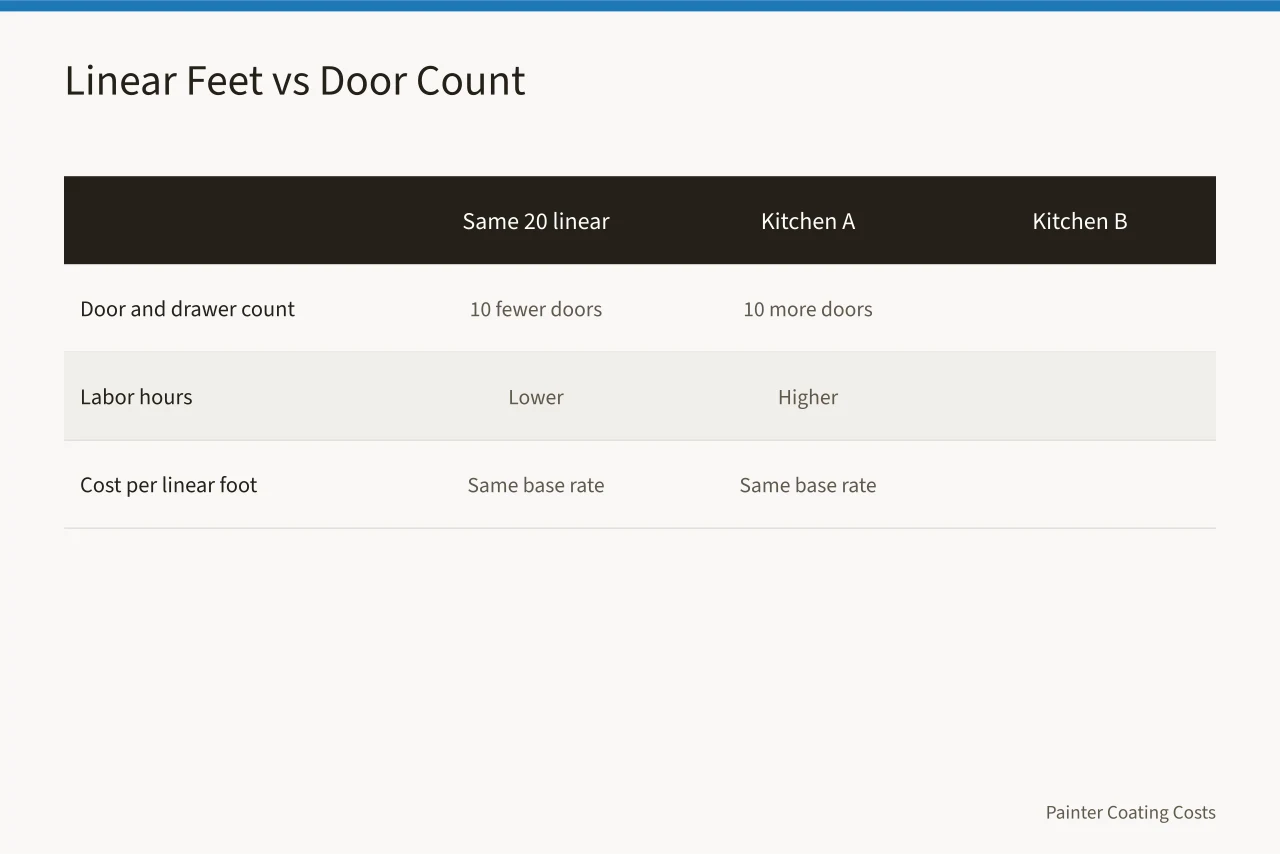
Linear feet are a rough proxy for door and drawer count. Two kitchens of the same length can differ by ten doors, and doors are where the hours go.
Line by line
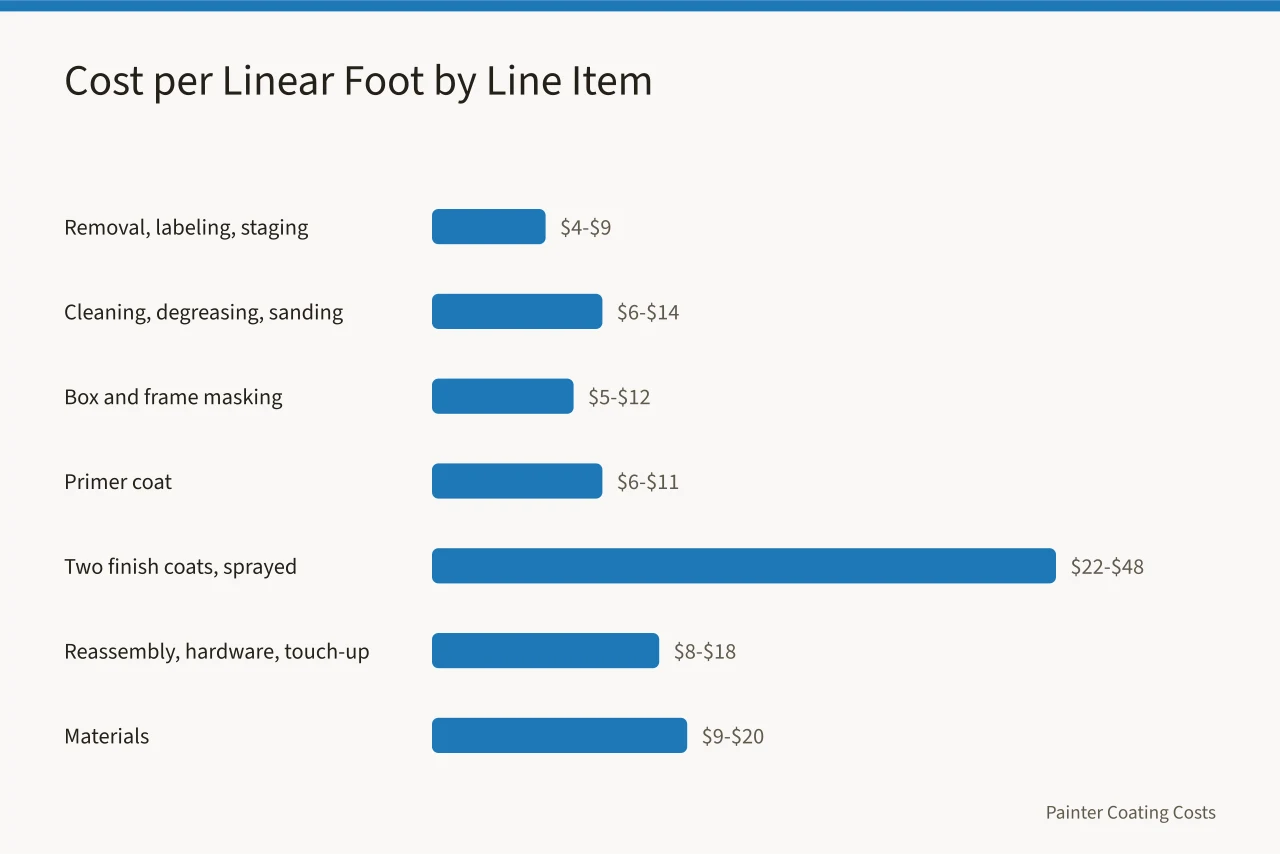
The table below is illustrative of a mid-size US metro in 2025. Your market will sit somewhere inside the range.
| Line item | Low | High |
|---|---|---|
| Removal, labeling and staging of doors and drawers | $4 | $9 |
| Cleaning, degreasing and sanding | $6 | $14 |
| Box and frame masking | $5 | $12 |
| Primer coat | $6 | $11 |
| Two finish coats, sprayed | $22 | $48 |
| Reassembly, hardware and touch-up | $8 | $18 |
| Materials (primer, topcoat, tape, paper) | $9 | $20 |
| Lead-safe handling, pre-1978 only | $10 | $45 |
| Total per linear foot | $70 | $177 |
The spread is not random. A slab door with a factory finish takes far less labor than a raised-panel door with a routed profile, and the finish coats are where that difference shows up.
What moves the number
Door profile. Flat slab doors are the cheapest to spray. Shaker and raised-panel doors need more passes to cover the recesses. Expect $15 to $30 per foot more for heavy profiles.
Finish type. A waterborne acrylic topcoat cures faster and costs less in labor than a conversion varnish or lacquer. The material gap is small; the schedule gap is large.
Spray versus brush and roll. Spray gives a smoother finish and costs $20 to $40 per foot more, because every surface in the room gets masked. Brush and roll is slower per coat but needs almost no protection work.
Condition of the boxes. Water damage, failed finish and swollen particleboard all add prep hours. Repainting kitchen cabinets that were painted badly once is often the most expensive version of this job.
What quotes leave out
Most cabinet painting quotes do not mention what happens if the doors are not removed. On-site spraying with doors in place is cheaper and looks worse at the edges.
Fewer still mention lead, and if a house was built before 1978, the federal Renovation, Repair and Painting rule applies to work that disturbs painted surfaces. Contractors must be certified and follow lead-safe practices.
The EPA RRP program page spells out firm certification and work practice requirements. Our breakdown of EPA RRP lead-safe rules and your painting estimate covers how that changes bids on older housing.
Worker exposure is a separate rule. The OSHA lead standard sets exposure limits that can force respirators and air monitoring, which adds labor hours to the job.
Low-VOC products are also worth pricing in. The EPA guide to VOCs and indoor air quality explains why a kitchen cabinet finish matters more than a wall paint in a small, poorly ventilated room.
Example
A 24-linear-foot kitchen with Shaker doors, sprayed off-site, in a 1965 house:
- Removal and labeling: 24 x $7 = $168
- Clean, sand, repair: 24 x $12 = $288
- Masking and booth setup: 24 x $9 = $216
- Primer and two topcoats: 24 x $38 = $912
- Reassembly and touch-up: 24 x $14 = $336
- Lead-safe containment and cleanup: 24 x $22 = $528
That lands near $2,450, or about $102 per linear foot, before sales tax and any hardware replacement.
Where people overspend
Paying for a sprayed finish on cabinets nobody sees is the most common waste. Pantry interiors and the backs of doors do not need the same coating as the fronts.
Second is refinishing instead of replacing when the boxes are failing. New doors on sound boxes are usually a better buy than coating over swollen particleboard.
Third is choosing a premium topcoat for a rental unit. The durability gap rarely pays back inside a five-year hold. If you are pricing repeat work for a landlord, the referral economics of a painting business matter more to your margin than the finish brand.
Two more habits protect the number. Photograph every door and drawer before removal, and write the linear-foot count into the contract so a change order has a baseline. For crews scaling this work, the first-weeks training checklist for a new hire covers the handling steps that cause most callbacks.
Common questions
Is per-linear-foot pricing standard for cabinet painting?
It is common in US markets but not universal. Some contractors price per door and drawer, which tracks labor more closely. Ask which method the quote uses before comparing two bids.
How much does spray painting cabinets cost compared with brush and roll?
Expect $20 to $40 more per linear foot for spray. The premium buys a smoother finish and a shorter cure window, not more coats.
Does lead paint always add cost?
Only when the work disturbs painted surfaces in pre-1978 housing. Testing or assuming positive is the safe path, and the added containment typically runs $300 to $1,500 per kitchen.
How long does the job take?
Most kitchens take four to seven working days door-to-door, mostly curing time between coats. Schedule matters more than price when the kitchen is out of service.