Guides
Los Angeles VOC rules: coating products and repaint pricing
South Coast AQMD VOC limits set which coatings you can apply on Los Angeles repaints, and they move both your material line and your schedule.
What to take away
- The South Coast Air Quality Management District writes the architectural coatings rule for Los Angeles, Orange, Riverside and San Bernardino counties. That rule, not the federal baseline, sets the VOC ceiling on what you can legally apply.
- Limits are per category, in grams of VOC per liter of coating minus water and exempt solvents. Flat exterior wall, roof, traffic marking and clear wood finish carry the tightest ceilings.
- A compliant gallon turns non-compliant if your crew thins it on site. Keep thinner off the truck unless the product data sheet allows it.
- Compliant waterborne coatings often cost more per gallon and cover less per coat. Ask the maker for coverage at your specified film thickness instead of using the label range.
- Recoat windows and moisture sensitivity push labor into the next day. That scheduling cost usually beats the material premium on a multifamily repaint.
What the South Coast AQMD rule covers
The district's architectural coatings rule governs field application, not just manufacture. Repaint and maintenance work on apartment blocks, retail centers and parking structures falls inside it.
Current rule text and amendments live on the district's AQMD rules and compliance page. Read the category table there before you bid, because amendments change ceilings.
VOC content is measured as grams per liter of coating, minus water and exempt solvents. Every product category gets its own number. A flat exterior wall paint and a clear wood finish do not share a limit.
Federal law sits underneath. The EPA sets national VOC and ozone policy that states and districts build on, and its Air Topics | US EPA hub shows how those programs stack.
Los Angeles also holds a large stock of pre-1978 housing. The EPA Lead Renovation, Repair and Painting Rule applies to many repaints of those buildings, so VOC compliance and lead-safe work practices land on the same job. Our compliance checklist covers the paperwork side of that overlap.
Which coating categories face the tightest limits
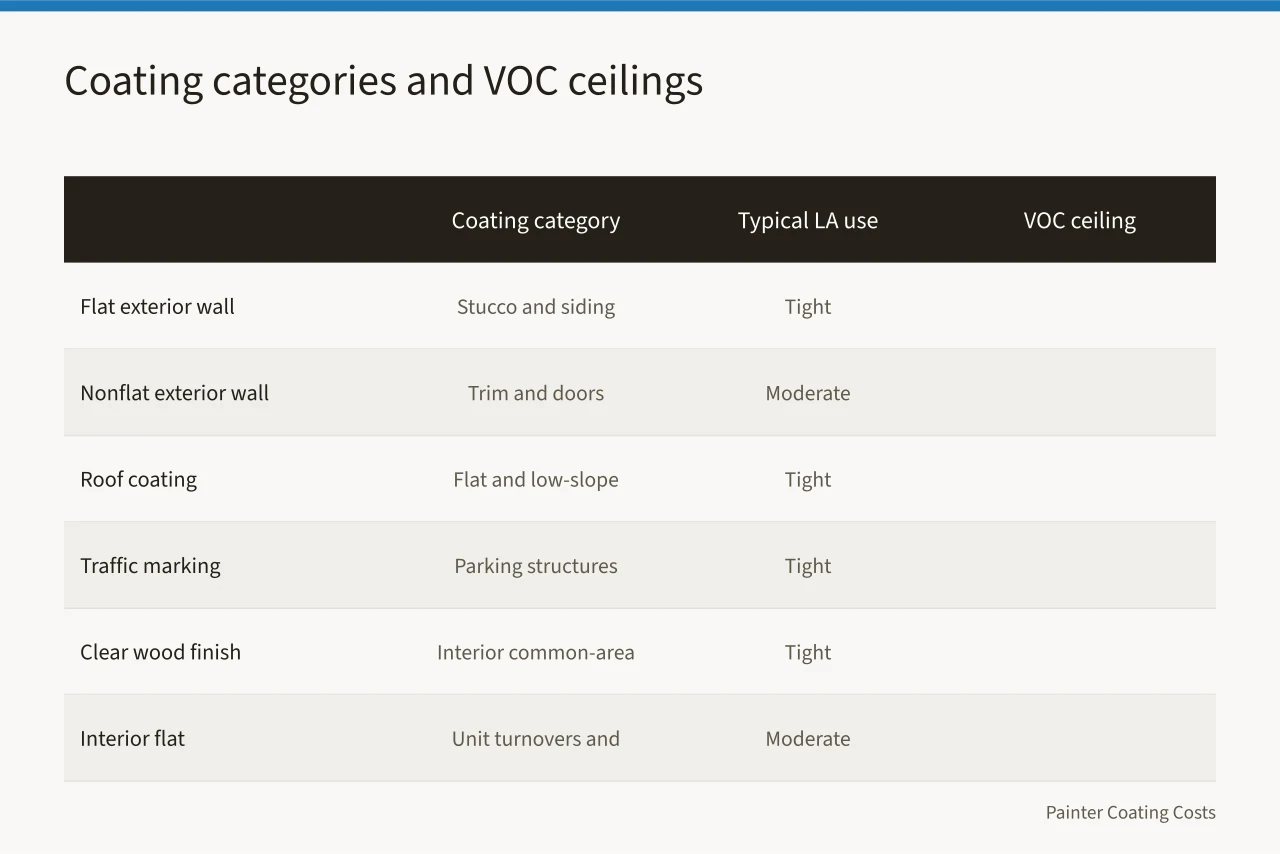
The district splits architectural coatings into dozens of categories with widely different ceilings. The ones that matter most on multifamily and commercial repaints are the tightest.
| Coating category | Typical use on LA multifamily jobs | Relative VOC ceiling |
|---|---|---|
| Flat exterior wall coating | Stucco and siding on apartment blocks | Tight |
| Nonflat exterior wall coating | Trim, doors, touch-up | Moderate |
| Roof coating | Flat and low-slope roofs | Tight |
| Traffic marking coating | Parking structures and garages | Tight |
| Clear wood finish | Interior common-area wood | Tight |
| Interior flat coating | Unit turnovers and hallways | Moderate |
Roof coatings are the common trap. A property manager asks for an elastomeric roof coating inside a repaint scope, and the cheapest can on the shelf exceeds the limit. Check the category before you quote.
Traffic marking and clear wood finish are small in dollars and large in compliance risk. A parking structure stripe job can draw a violation as easily as a full building repaint.
Interior flat coatings are less restricted, which is why unit turnover work stays easier to keep compliant. The district still expects the labeled product to match the labeled use.
Reading a compliant product list
The district registers products by category, and most major manufacturers publish compliant lines with the same data. Work the list in this order:
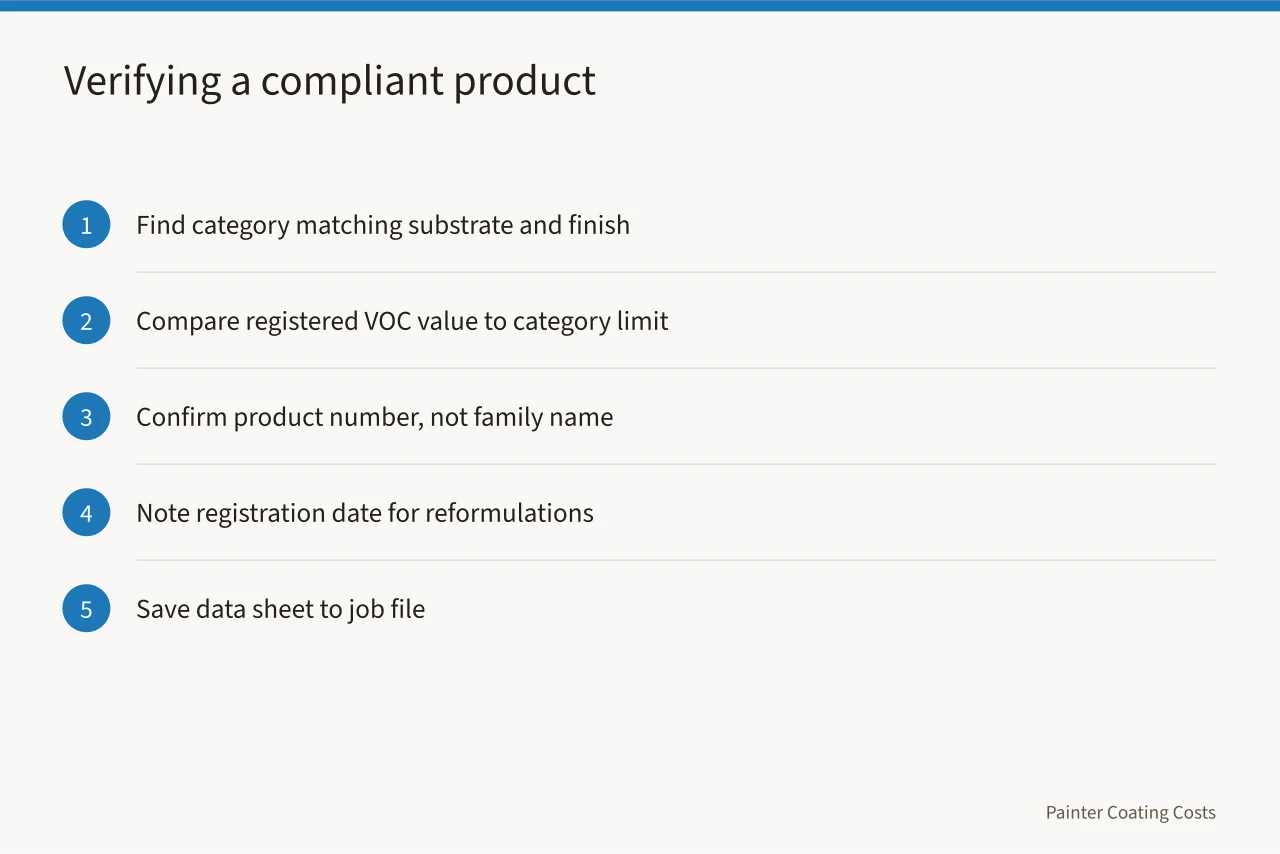
- Find the category matching your substrate and finish.
- Compare the registered VOC value against that category's limit.
- Confirm the product number, not just the family name.
- Note the registration date, since reformulations happen.
- Save the data sheet to the job file before the crew mobilizes.
Manufacturer names change faster than category codes. A paint that passed two years ago may have been reformulated, so verify at bid time and again at delivery.
Treat a supplier substitution as a new product. Recheck the category and the VOC number, then confirm the swap in writing with the owner.
For the rulemaking structure that state and district programs sit inside, the EPA's Regulations | US EPA page is the federal starting point.
How compliant products move the material line
The material impact on a Los Angeles repaint is usually a modest share of the total, but it is not zero. Two costs move together: price per gallon rises, and gallons per square foot can rise if hide is weaker.
Ask the manufacturer for coverage rates at your specified film thickness. Label ranges are optimistic and they are not a bid basis.
Primer choice matters too. A compliant primer may need a longer dry before topcoat, which pushes labor into the next day and changes crew sizing.
Bid the coating as its own line item with a gallon count and a stated coverage assumption. When the property manager asks why the paint line is higher than last cycle, you have a defensible answer. The same discipline shows up in how you set prices for profit across every service line.
Do not absorb the difference silently. Contractors who eat material increases on a three-building repaint rarely recover them on the next bid.
Scheduling and application on occupied buildings
Scheduling under VOC rules is mostly dry time and access. Compliant waterborne coatings stay sensitive to humidity longer, and coastal Los Angeles mornings are damp well into spring.
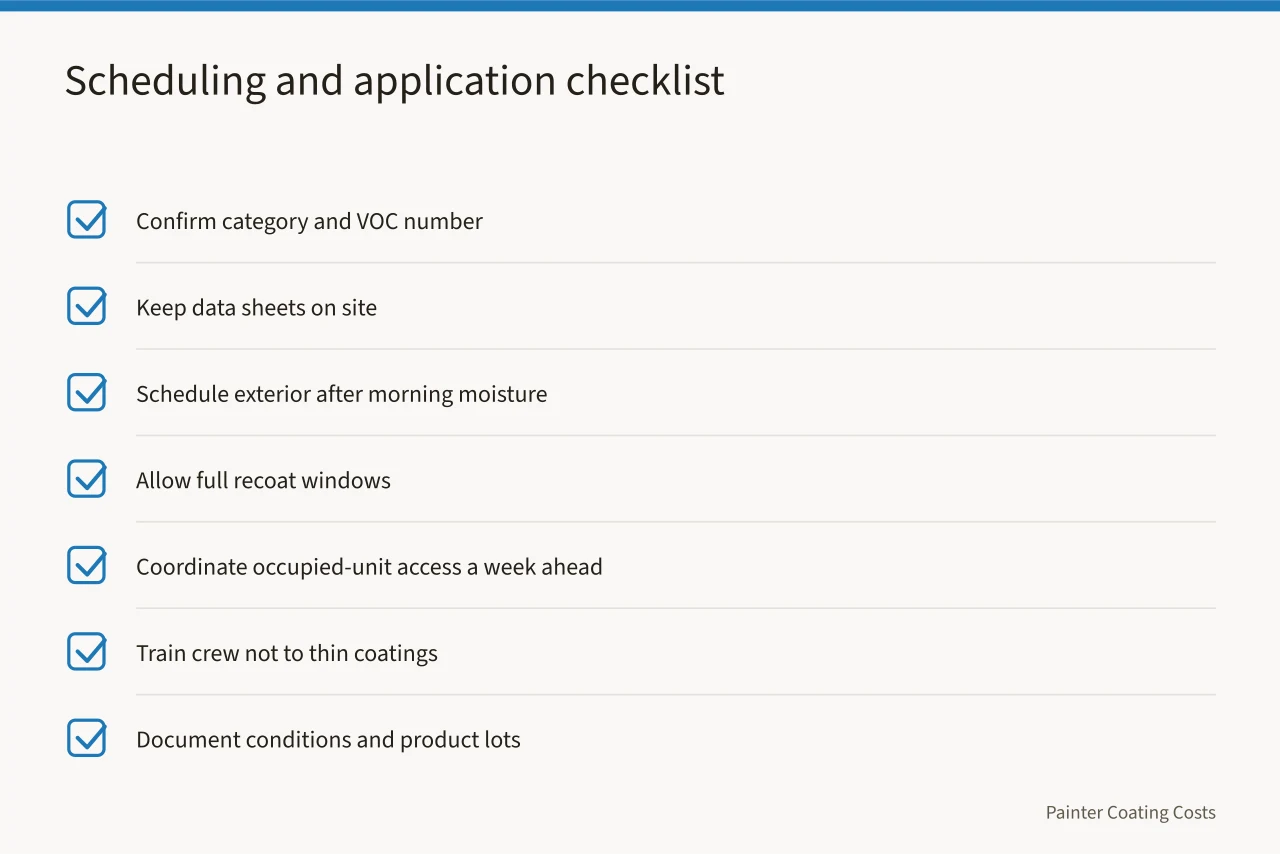
- Confirm category and VOC number for every product on the job.
- Keep product data sheets on site for the duration of the work.
- Schedule exterior wall coating after morning moisture burns off.
- Allow full recoat windows instead of forcing a second coat the same day.
- Coordinate occupied-unit access with the property manager a week ahead.
- Train the crew not to thin coatings unless the data sheet allows it.
- Document conditions and product lots for every building in scope.
Occupied buildings add a second constraint. Tenants need notice, common areas need protection, and elevators get booked for paint delivery. One extra hour of dry time can ripple through a week of turnovers.
Marine layer, Santa Ana wind events and summer heat all change how a waterborne coating sets. Build float into the schedule instead of promising a fixed completion date.
Crew training is a scheduling input. A painter used to solventborne products will over-apply a waterborne coating and slow the job. Verify work against a quality assurance checklist at each phase.
Pricing a multifamily or commercial repaint
Price scope first, then layer compliance cost on top. Work the job in this order:
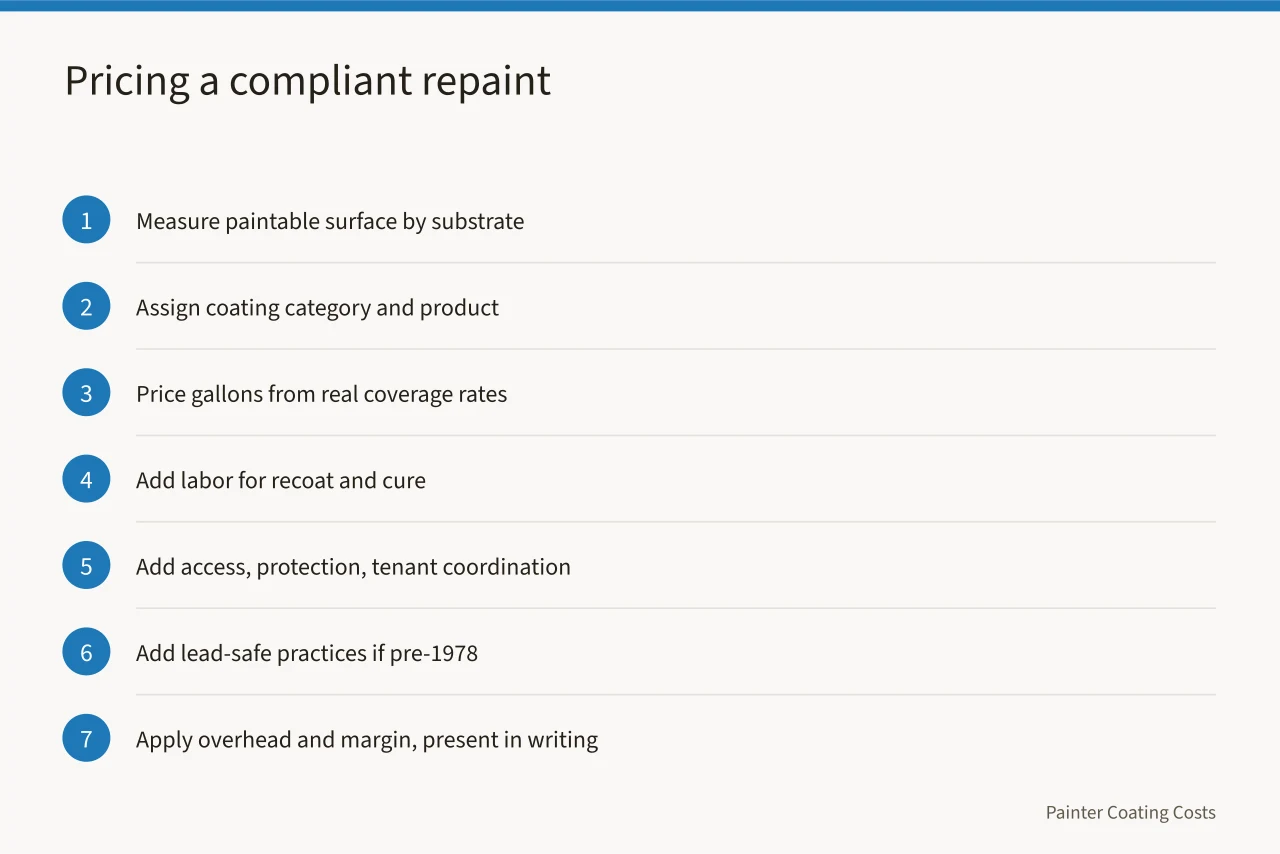
- Measure paintable surface by substrate and finish.
- Assign each surface to a coating category and pull the compliant product.
- Price gallons from real coverage rates, not label maximums.
- Add labor for the recoat and cure windows the product requires.
- Add access, protection and tenant coordination.
- Add lead-safe work practices if the building predates 1978.
- Apply overhead and margin, then present the scope in writing.
A worked example. Take a 60-unit, three-story building with stucco walls and a flat roof. Exterior wall coating and roof coating both sit in tight categories, so both products carry a premium.
If the roof coating needs two coats with a full day between them, the schedule grows a day per building section and the labor line grows with it.
Commercial work follows the same logic with tighter access. Retail centers, offices and parking structures often require night work, which raises labor cost before any coating premium. Price the shift differential as its own line so the owner sees it.
Bundling offsets some compliance cost. When a property wants exterior paint, roof coating and interior common areas in one cycle, you mobilize once. That is the logic behind packaging work as combined services and packages rather than single-trade bids.
Track which lines actually carry margin under these rules. Roof coating and traffic marking can run thin after compliance cost, while interior turnover stays steady. Knowing where the money sits is the same exercise as tracking profit by service across your book.
For documentation an owner may ask for, the EPA's Laws & Regulations | US EPA hub and its Regulatory Information By Business Sector | US EPA page organize rules by topic and by trade.
Common questions
Do South Coast AQMD VOC limits apply to repaints, not just new construction?
Yes. The architectural coatings rule covers field application on repaint and maintenance work, including multifamily and commercial buildings. Check the current category table on the district's rules page before you bid.
Can I use leftover high-VOC paint from an older job?
No. The limit applies to what you apply, regardless of when the product was purchased. Verify the category and VOC number before the crew opens the can.
How much more do compliant coatings cost per gallon?
It varies by category and brand. Compliant waterborne products often cost more per gallon than the solventborne products they replace, and coverage can differ, so price from real coverage rates rather than a rule of thumb.
Does VOC compliance change the schedule on a multifamily repaint?
Usually yes. Recoat windows, cure time and moisture sensitivity can add days, especially on exterior wall and roof coatings. Build that float into the bid instead of absorbing it later.