Guides
How Miami salt air and HOA rules shape exterior coating costs
Miami exterior coating costs salt air HOA rules raise every repaint: salt prep, corrosion and mildew products, and condo approval add line items.
What to take away
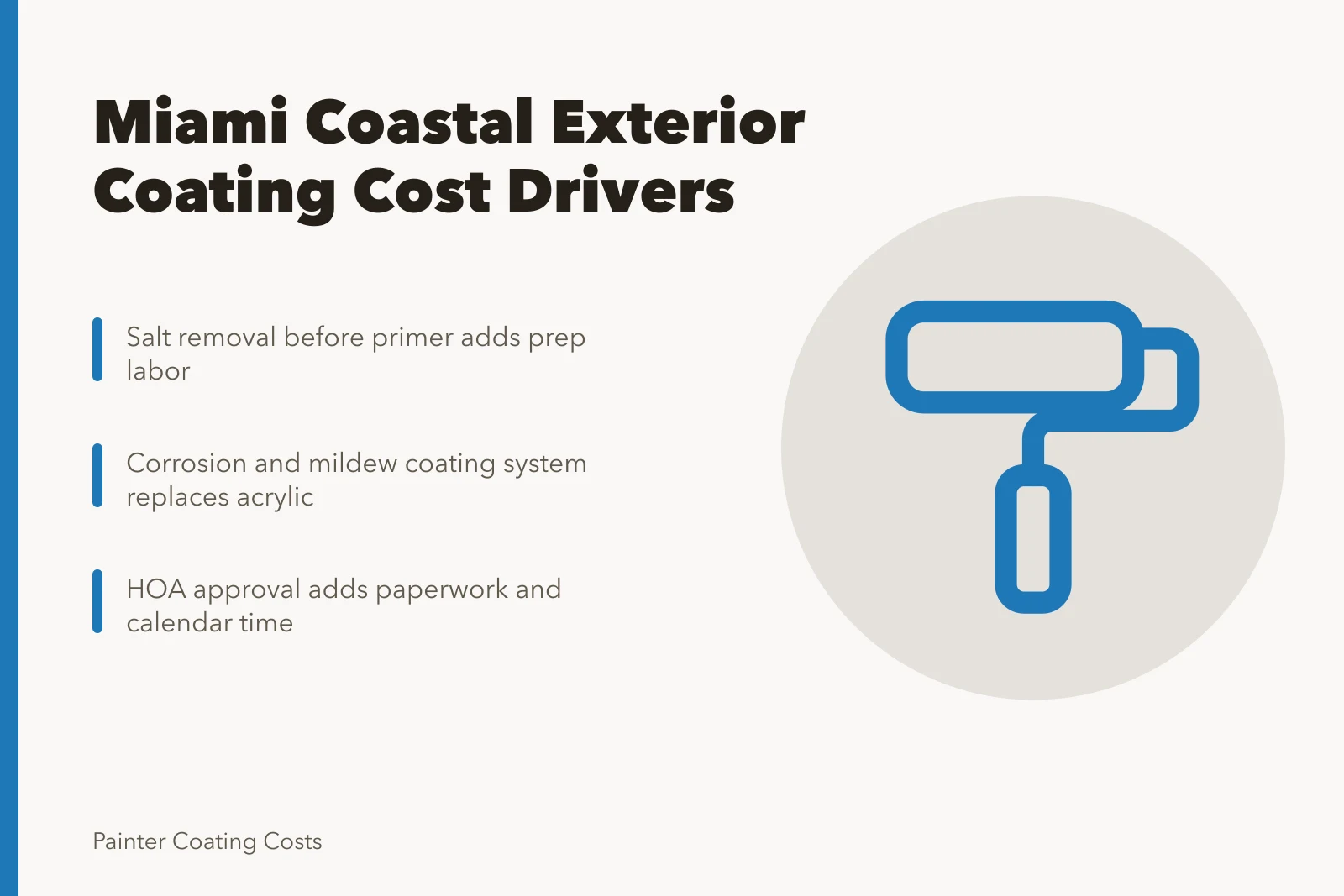
- Three lines carry the coastal premium: salt removal before primer, a corrosion and mildew coating system instead of builder-grade acrylic, and association approval paperwork.
- Prevailing onshore wind drops chloride on every elevation facing open water, and that film holds moisture against the wall long after rain stops.
- Prep labor, not coating application, is the biggest variable on a weathered coastal building.
- HOA and condo approval costs calendar time as well as office hours, and work-window limits cut daily production.
- Storm season decides whether a repaint is planned work or emergency repair, and those two price differently.
What salt air does to exterior coatings in Miami
Miami sits between Biscayne Bay and the Atlantic. Onshore wind carries aerosolized chloride onto every elevation facing open water, and that salt film is hygroscopic: it pulls moisture into the coating and keeps the wall wet after the rain ends.
On bare stucco and masonry, chloride ions migrate into the pores. Moisture follows, and the coating loses adhesion from the substrate up. Blistering shows first near the base of walls and around window openings, where spray concentrates.
Metal fails faster than masonry. Aluminum railings, steel lintels, fasteners and screen frames pit and chalk, and paint over a corroding substrate will not hold no matter what topcoat goes on it.
Humidity feeds mildew on north and east elevations that stay damp and shaded. A finish that is not mildew resistant becomes a food source, and growth returns inside a season.
That is why a Miami repaint is a corrosion and moisture control job that happens to change color. Contractors who scope it that way price it correctly, and the ones who quote it as a cosmetic repaint eat the callback.
Corrosion-resistant and mildew-resistant product selection
Start with the primer, not the finish. On bare or chalky masonry, a penetrating or alkali-resistant primer blocks moisture movement through the substrate. On ferrous metal, a zinc-rich or epoxy primer is the base for any topcoat system.
For the finish coat, specify products formulated for coastal exposure: acrylic or acrylic-modified systems with UV-stable pigments, and elastomeric coatings where hairline cracking is present. Salt fog resistance matters more than sheen level, and it is the property to ask the manufacturer's rep about.
Mildew resistance is a separate specification. Mildewcides in the can deplete over time, so a film that resists growth on its own matters on north-facing walls and in shaded courtyards.
Stay inside one manufacturer's system from primer to topcoat. Mixing brands voids most warranties, and the coastal warranties are the ones worth holding.
Product tier moves material cost more than anything else on the estimate. A premium coastal system can run two to three times the material cost of builder-grade acrylic, and that gap is the first line a property manager questions. For how service mix shifts margin across a painting company, see our breakdown of the most profitable painting contractor services.
| Elevation or component | Exposure | Typical system | Why |
|---|---|---|---|
| East and south walls | Direct salt spray, driving rain | Alkali-resistant primer plus acrylic coastal topcoat | Chloride wash-off and UV |
| North and shaded walls | Damp, low sun | Mildew-resistant primer plus mildew-resistant topcoat | Growth control |
| Ferrous metal | Salt fog, humidity | Zinc-rich or epoxy primer plus acrylic or polyurethane topcoat | Corrosion barrier |
| Concrete balconies | Ponding, salt | Elastomeric or waterproof membrane coating | Crack bridging, water intrusion |
| Wood trim | Sun and rain cycling | Exterior alkyd or acrylic primer plus acrylic topcoat | Adhesion and grain sealing |
Surface prep for salt exposure and moisture
Prep is where the coastal line item is earned. Skipping a step here is the fastest route to a callback in Miami.
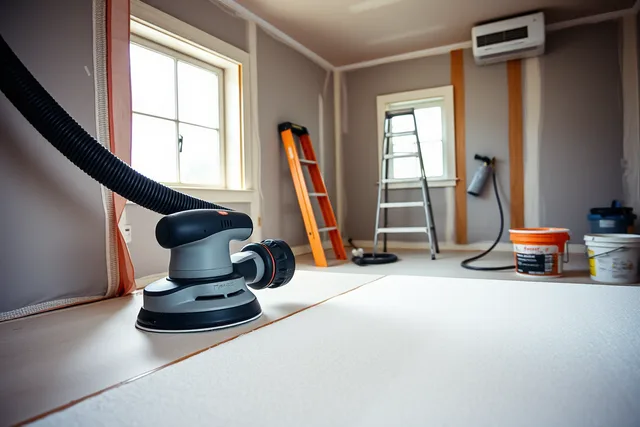
- Wash the whole surface with a contractor-grade detergent or a mild bleach solution to strip salt, chalk, dirt and mildew. Rinse at low pressure and let it dry.
- Scrape and sand loose coating, feather the edges, and spot-prime bare areas before full priming.
- Treat mildew with a solution mixed to the coating manufacturer's direction, then rinse and dry completely.
- Repair cracks, spalls and failed sealant joints, and let patching cure.
- Prime the full surface with the specified primer, then apply finish coats inside the manufacturer's recoat window.
Check moisture before any coating goes on. Masonry that reads damp traps water under the film, and a meter reading on a few elevations prevents a whole-project failure.
Dark staining on shaded walls is often mildew, not dirt, and property managers frequently assume otherwise. The EPA's mold guidance page explains how moisture and biological growth interact.
Prep labor is the largest variable in a coastal estimate. Pressure washing, hand scraping and crack repair can consume more crew hours than coating application on a badly weathered building.
HOA and condo approval steps that add cost and time
Most Miami exterior repaints inside a planned community or a condo tower need association approval before a brush touches the wall. Approval is a cost item, not only a scheduling item.
- Submit an architectural or paint application with color samples and product data sheets.
- Get board or architectural review committee approval, often at a monthly meeting.
- Confirm the approved palette matches the recorded scheme, since some associations restrict color changes.
- Provide proof of insurance and licensing before the work window is granted.
- Schedule around noise, elevator and access restrictions, then notify residents.
Every step costs something. Sample boards, color matching and data sheet packages take office time. A monthly board calendar can push a start date by weeks. Work-hour limits on occupied buildings cut daily production.
Condo associations often require higher liability limits and want the association named as additional insured. That belongs in the bid as its own line, not buried in your margin. Our guide to painting contractor insurance costs and coverage covers what those endorsements do to a policy.
Photograph existing conditions before you start. A dated photo log settles a resident's claim about a scratch or stain that predates the job.
Line-item cost build-up for a Miami exterior repaint
Show every cost separately so an association can compare bids on equal terms.
- Mobilization, protection and resident notification
- Pressure washing and salt removal
- Scraping, sanding and spot priming
- Mildew treatment and rinsing
- Crack, spall and sealant repair
- Full-surface primer
- Finish coats, two on exposed elevations
- Metal railing and trim coating
- Cleanup, touch-up and final walkthrough
Labor dominates most Miami repaints because prep and access eat hours. Material is second and scales with the coating system you specify. Access equipment, from ladders to swing stages, is a third bucket that tracks building height.
Administrative cost covers the approval package, scheduling coordination and compliance paperwork. It is small in dollars and large in calendar time, which is why it belongs in the schedule as well as the bid.
Price prep from measured conditions, not a square-foot average. Coastal buildings vary too much for one rate. Our guide to painting contractor pricing and profit walks through the margin math.
If you are weighing whether coastal repaint work justifies the compliance overhead, compare it against other service lines when you are choosing a market for your painting business.
Storm season timing and hurricane outlook
Hurricane season runs June 1 through November 30, and it moves Miami exterior painting demand more than any marketing spend. NOAA maintains its prediction for a below-normal Atlantic season, which still includes the possibility of landfall. The agency's Atlantic hurricane season outlook has the full picture.
Demand splits two ways. Planned repaints cluster in the drier, cooler months when curing conditions hold. Storm work spikes after any named system, when associations need repairs fast and insurers want documentation.
NOAA's national weather data is where to check storm tracks and rainfall patterns that affect scheduling and cure times. High humidity and afternoon storms slow dry times, and recoating too soon causes film failure.
Insurance-funded repaint demand rises after a major storm. FEMA's business assistance programs are part of how owners and contractors sort out recovery funding after a declared disaster.
Book planned work before the season peak and hold capacity for storm response. Both are forces you can plan around rather than only react to, and our compliance checklist for new painting contractors covers the paperwork side of that planning.
Common questions
Why does a Miami exterior repaint cost more than an inland Florida repaint?
Salt removal takes longer, coastal coating systems cost more, and association approval adds administrative work. The climate also narrows the window when coatings cure properly, which stretches the schedule.
Do I need mildew-resistant coating if the building is repainted every few years?
Yes, on shaded and north-facing elevations. Miami humidity keeps those surfaces damp, and mildew returns quickly when the film is not formulated to resist it.
How long does HOA or condo approval take in Miami?
It depends on the association's meeting schedule and review process. Some boards approve by email between meetings, while others wait for a monthly architectural review session.
What drives the biggest cost swing between two bids on the same building?
Prep scope and coating system. One bid may assume light washing and builder-grade acrylic, while another prices full salt removal and a coastal system.